







 TikTok Advertising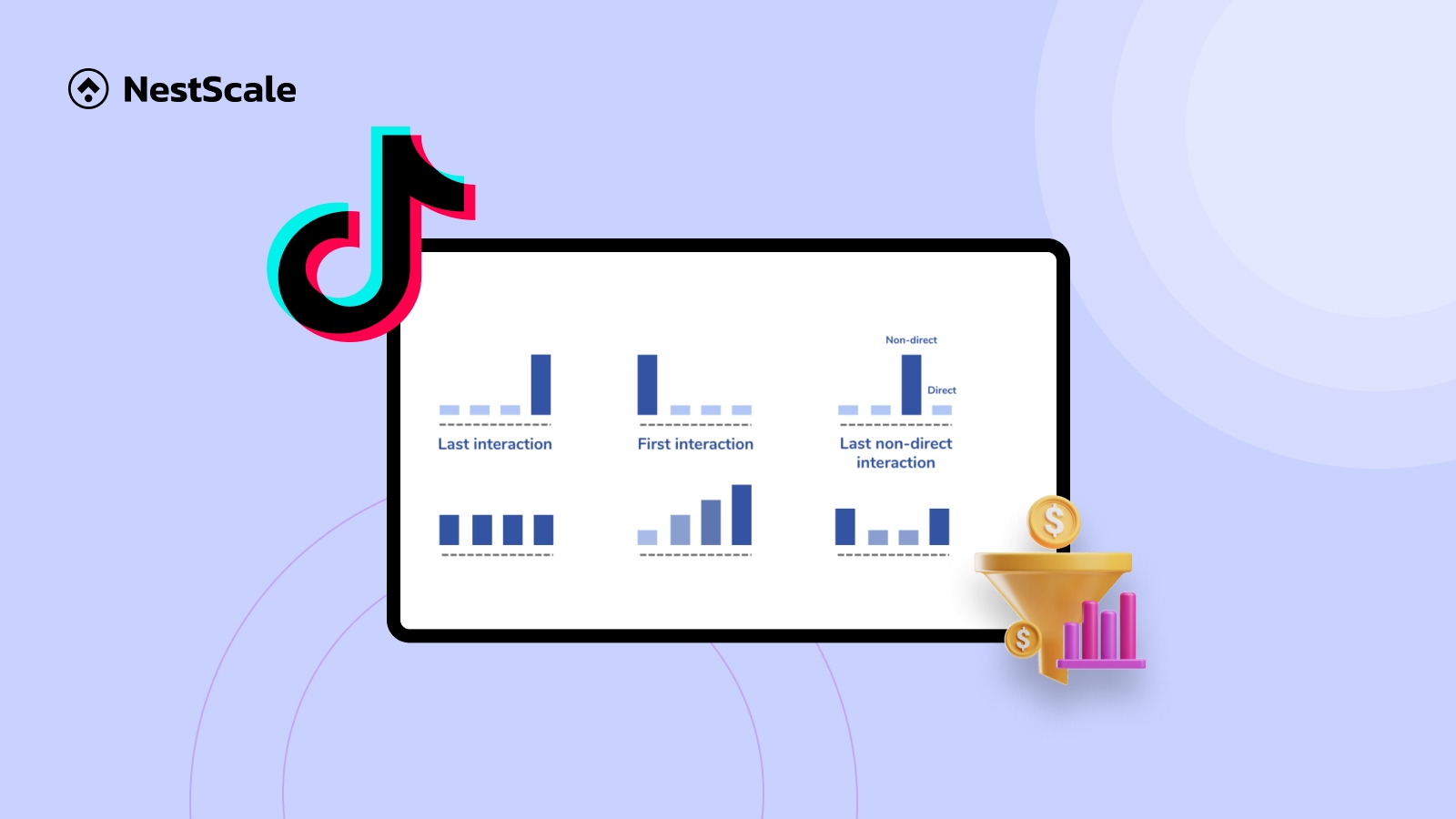
You have spent hundreds, or thousands of dollars on TikTok ads. Yet, your ecommerce store has recorded zero sales.
I know how frustrating this situation can be for your business. When a TikTok ad campaign fails to convert, it means there is a specific breakdown in your marketing funnel. In this guide, we will look at each possible scenario and what you can do to improve.
TL;DR: If your TikTok ads are not generating sales, the issue resides either within the TikTok ad or on your website storefront. To fix this, you must ensure that your landing page matches the promises in your ads. Plus, your data tracking should be accurate and does not miss conversions due to outdated tracking models.
Why Are You Getting No Sales from TikTok Ads?
I have come up with 4 scenarios to explain why are your TikTok ads not converting:
- Worst scenario: Low views, low CTR
- Scenario 2: High views, low CTR
- Scenario 3: High clicks, but no sales
- Scenario 4: Add-to-cart, but no payments
Worst scenario: Low views and low CTR
The Main Reasons Why
When an ad group receives very low view or even 0 view counts and a poor click-through rate, your campaign is either suffering from:
(1) Underwhelming delivery: The TikTok ad auction rewards engaging content. If your ad doesn’t hook the audiences within the first 3-second, they will keep scrolling.
(2) Your audience targeting might be too narrow: If the algorithm cannot find suitable users within your small budget, it stops serving your ad entirely.
For example, you launch a campaign to sell customized coffee mugs. You set your daily budget to $10 and restrict your target audience to people who live in one specific zip code and like vintage pottery. After 48 hours, your ad has only reached 80 views and generated 0 clicks. Your budget has not spent because your targeting is too small.
What You Can Do to Improve
You need to broaden your audience targeting a bit. TikTok officially advises merchants to use wide TikTok ads targeting options for conversion campaigns. The system will find customers based on how real users engage with your video content.
Ensure that your video file has a high resolution and starts with immediate visual movement to encourage viewer retention.
Scenario 2: High Views but Very Low Click-Through Rate (CTR)
The Main Reasons Why
If your ad receives thousands of views but your CTR is below 0.60%, you have a creative issue.
The TikTok algorithm is successfully showing your video to users, but those users do not click your link.
First, you need to know that as soon as your video starts playing on a user’s screen — even for a split second — TikTok counts it as a view.
So high views does not mean high engagement, and certainly does not equal sales. You can check engagement rate with TikTok analytics.
The main reason for a low CTR is, to be honest, the obvious advertisement from brands and lack of UGC (User Generated Content).
TikTok users love authenticity. If they know that your video is a sponsored ad, they will most likely swipe past it. Your video must blend into the native platform style while capturing user attention within the first three seconds.
What You Can Do to Improve
You need to get other content creators to speak for your products. Capturing their thoughts and reactions from opening the package to showcasing your products in use. TikTok thrives on UGC and if one performs well, you can use it as an ads with TikTok Spark Ads.
Avoid formal transitions and use clear calls to action that tell the viewer exactly why they should click your link.
Scenario 3: High Clicks but Zero Sales
The Main Reasons Why
When your campaign maintains a healthy CTR above 1.00% but generates zero sales, the issue is mostly like your website.
Your TikTok ad is working correctly because it successfully sends interested traffic to your store. The breakdown occurs after the user leaves the TikTok application.
The primary reason for this issue is a poor user experience or mismatched landing pages.
Your landing page may take too long to load, or you put an annoying pop-up right as the user enters.
And yes, if there is a disconnection between what your ad just showed and what the customer see on the linked page, they will bounce immediately.
What You Can Do to Improve
First, make sure that you link to the right page. If your ads are promoting specific products, avoid linking to the homepage.
Plus, you must optimize your product pages, especially for mobile devices. The majority of TikTok users are scrolling on their phone. Test your store layout directly on a mobile phone to ensure that text is readable and buttons work smoothly.
🚨Important: Your zero sales data might not be accurate. This happens because of the difference between first click and last click attribution models.
TikTok often acts as a first click discovery platform. A user can click your ad, remember your product, then buy it some other times. Your store backend will show high clicks and zero sales for TikTok, even though your TikTok ad started the entire journey.
To fix this tracking blind spot, you should explore multi-touch attribution model.
Scenario 4: Add-to-Carts (ATC) but No Complete Payments
The Main Reasons Why
Getting high add-to-cart numbers without any final checkouts is a common point of failure. This data combination indicates that your traffic has high purchasing intent, but they encounter obstacles during the checkout flow.
There may be unexpected extra fees and checkout friction. High shipping costs and complex checkout forms account for the majority of abandoned shopping carts. When mobile users are forced to create an account or enter long credit card strings manually, they frequently abandon the purchase.
What You Can Do to Improve
You must streamline your final checkout steps to avoid shopping cart abandonment. First, eliminate mandatory account registration. Allow every customer to finish their purchase using a fast guest checkout option.
Second, add mobile-friendly payment options to your cart page. Options like Apple Pay, Google Pay, or PayPal allow customers to complete purchases securely with a single touch. Finally, minimize unexpected costs.
You can build your shipping fees directly into the price of your item. This adjustment allows you to advertise free shipping, which removes a major obstacle to completing a sale.
Key metrics and benchmarks for TikTok ads performance
To solve your sales problem, you need to look at your data objectively. Your advertising dashboard provides specific metrics that reveal where performance drops.
To help you, I put together a quick diagnostic baseline using the latest performance metrics from multi-brand tracking data:
| Ad Performance Metric | Action Required | Average Benchmark | High Performance Level |
|---|---|---|---|
| Click-Through Rate (CTR) | Below 0.60% | 0.84% to 1.10% | Above 1.75% |
| Cost Per Click (CPC) | Above $1.50 | $0.70 to $1.00 | Below $0.40 |
| Conversion Rate (CVR) | Below 1.00% | 1.80% to 2.40% | Above 3.50% |
Further reading: What Is a Good CTR For TikTok Ads?
How to track accurate TikTok ads performance?
Tracking your performance data accurately is one of the biggest challenges in modern social commerce. If you rely entirely on the standard TikTok Ads Manager dashboard, you will quickly notice data discrepancies.
TikTok might claim credit for ten sales, while your ecommerce backend shows only five. This gap happens because standard browser pixels struggle to track users across different devices and apps due to modern mobile privacy restrictions.
To fix this blind spot, you need a dedicated marketing attribution tool like NestAds – a TikTok ad analysis tool for Shopify merchants.
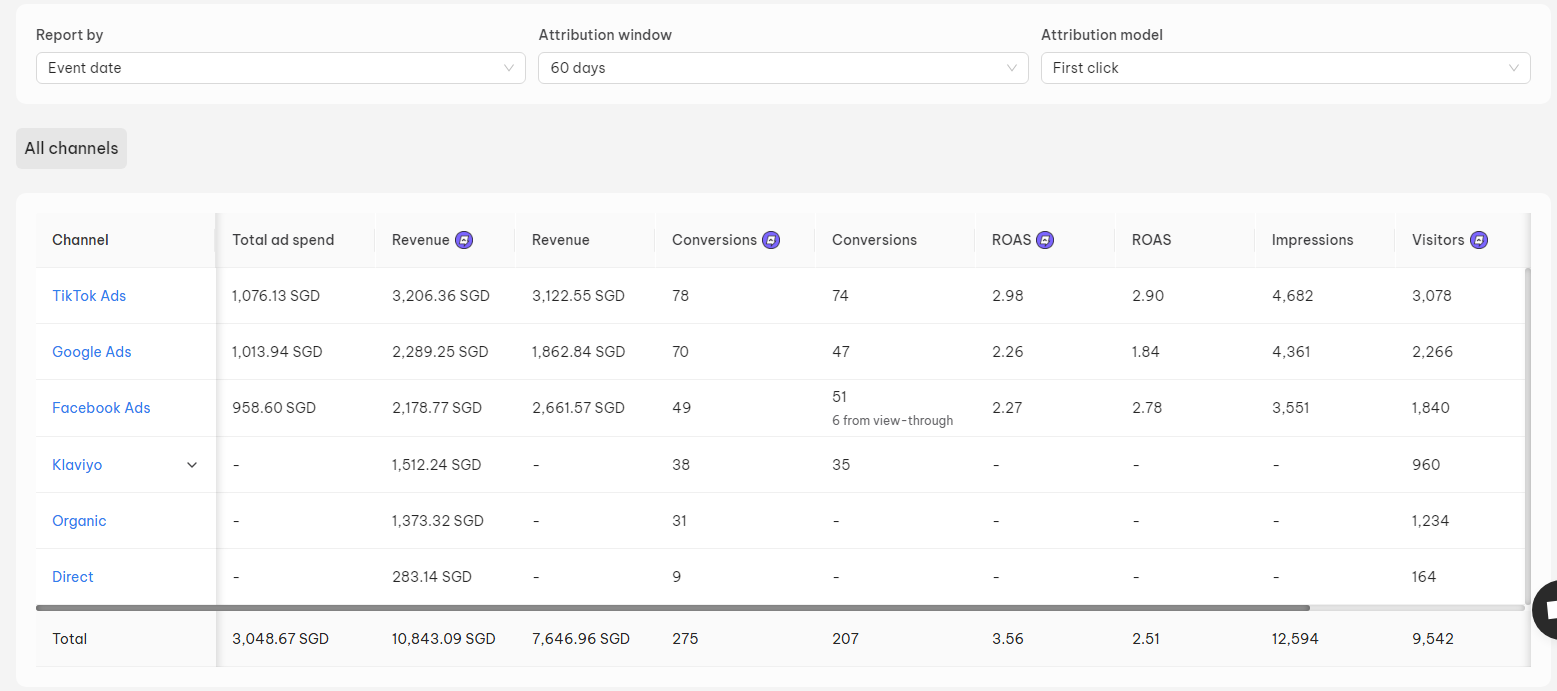
An attribution tool fixes this tracking problem by connecting all the steps a shopper takes before buying. Instead of looking at just one click, NestAds look at the entire customer journey.
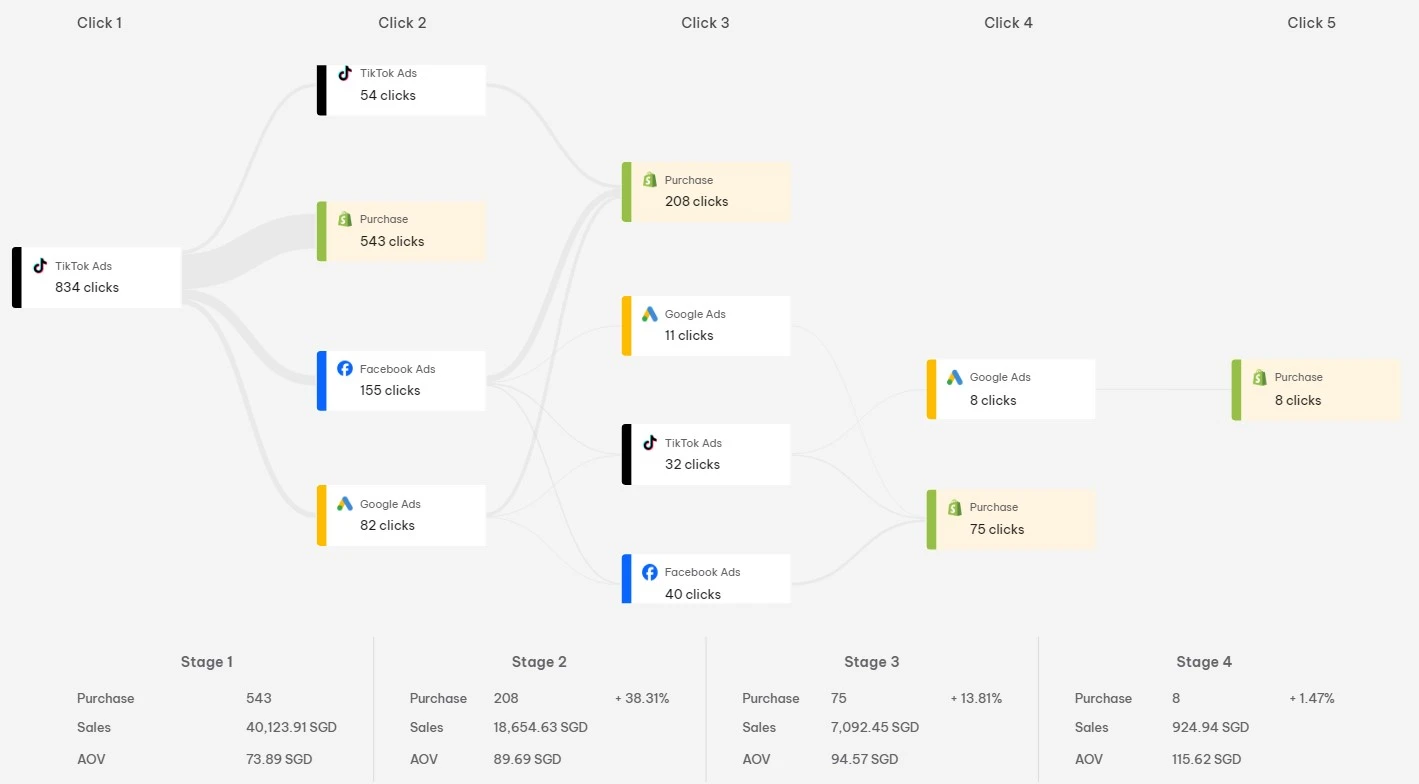
You can see exactly which TikTok video got the shopper interested in the first place. This helps you identify which ad is driving sales, and gain valuable customer insights.
If you are interested, book a demo or contact us.
FAQs: No Sales from TikTok Ads
You should let a new TikTok ad group run for at least three consecutive days before you decide to pause it. The platform utilizes an automated machine learning process to optimize your ad delivery. If you modify your budget or pause your campaigns too quickly, you reset this process.
You should allocate a daily budget that is at least three to five times your target cost per acquisition (CPA). For instance, if your product costs $30 and you want to spend $10 to get a sale, set your daily budget to at least $30 to $50 per ad group. TikTok requires a minimum daily budget of $20 at the ad group level to run campaigns.
Let your TikTok ad run for 3 to 5 consecutive days before making any adjustments. This timeframe allows the platform’s machine learning algorithm to find the right pocket of buyers within your target audience.
This performance pattern is caused by algorithmic testing variations. When you launch a completely new video asset, the platform provides an initial boost in exposure. Once that initial audience group is exhausted, the system expands delivery to a broader population of users. If your video does not maintain strong engagement signals, such as high watch completion rates, the system reduces its distribution.
To prevent this sudden drop in performance, avoid relying on a single video asset. Launch your ad groups with three to five different creative options so the algorithm can rotate your videos and maintain consistent performance.
To track your performance accurately, install a marketing attribution tool. Always match your TikTok Ads Manager dashboard data against your internal e-commerce platform analytics, like Shopify or Google Analytics 4, using custom UTM tracking parameters on your links.