







 Marketing Attribution
If you run paid ads for a direct-to-consumer (DTC) store or manage performance marketing accounts for clients, you already know that digital tracking is complicated and can not be 100% accurate. Privacy rules, browser limitations, and multi-channel ads mean that the data you see inside native ad platforms is often incomplete or biased.
In this list, I will take you through top marketing attribution tools for DTC brands. We will bypass the overly technical jargon and focus on the practical platforms that help you protect your profit margins.
💡 Key Takeaways
-
If you want a quick answer to find the right software for your specific business setup, here are the top recommendations from our review:
- NestAds: The best option for small-to-medium DTC ecommerce brands on Shopify that need simple multi-channel tracking and creative analysis.
- TrackBee: The best backend data solution for mid-sized brands that need to fix missing pixel data and feed clean, server-side sales events.
- TrueProfit: The top choice for inventory-heavy e-commerce stores that want to track real-time net profit margins.
How We Rank and Compare These DTC Attribution Tools
To find the best tracking tools for DTC brands, I look at the real daily problems DTC ecommerce store owners and media buyers face. Here are the three simple standards used to rank these tools:
- Real profit visibility: Most tools only show gross sales from ads. A good tool for DTC brands should connect your ad costs directly to your product conversions. This lets you see your actual net profit, not just a high revenue number that might mask a loss.
- Data accuracy and pixel: Since web browsers block traditional cookies, tools must use server-side tracking to capture missing sales.
- Attribution modeling and adaptability: Different ecommerce business models require different tracking model. I evaluate how well each tool makes up the gap of each attribution model, or offers custom attribution modeling.
Overall, the perfect marketing attribution model does not exist, but I can help you choose the tool best suitable for your business.
Quick Comparison Matrix: Top 7 DTC Attribution Tools at a Glance
Before we dive into the specific details of each software platform, you can review this quick overview. This table helps you spot which tool aligns with your brand size, primary channel strategy, and budget.
| Attribution Tool | Best Used For | Key Tracking Focus | Pricing Tier |
|---|---|---|---|
| NestAds | Shopify DTC brands | TikTok/Meta/Google creative paths & ad attribution | $129.99/month (flat rate) |
| TrackBee | CAPI Optimization & Data Repair | Server-side script enrichment & ad algorithm feeding | From $79/month (scale with revenue) |
| Rockerbox | Omnichannel Digital + Offline | Multi-touch cross-channel journey tracking | Enterprise pricing |
| TrueProfit | Product-Level Net Profit Tracking | Integrating COGS, shipping, and ad spend margins | From $200/month |
| Fospha | Privacy-First Statistical View | Upper-funnel lift via Marketing Mix Modeling (MMM) | From $1,500/month |
| BillyGrace | Lean Teams & Automated Scaling | AI-driven cross-channel budget rebalancing rules | From $599/month |
| Wicked Reports | Subscription Box & Repeat LTV | Long-term customer cohorts & email flow ROI | From $499/month |
Now, let’s break down the best multi-channel attribution tools on the market and how they solve specific operational problems for DTC ecommerce businesses:
1. NestAds
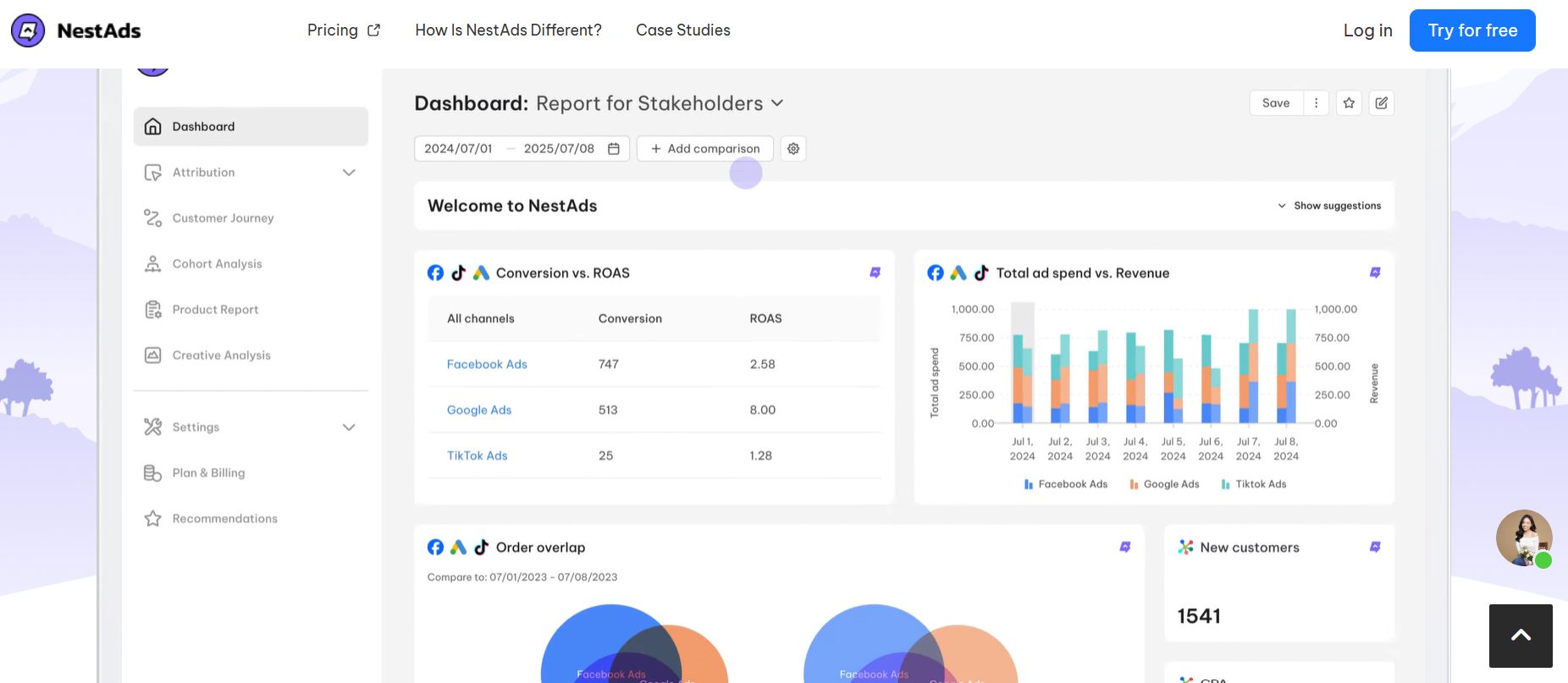
NestAds is built specifically for DTC ecommerce store owners who want to scale with marketing attribution without committing to an expensive enterprise-level software.
NestAds stands out from the competition because it focuses on creative asset performance rather than just broad channel metrics. While many platforms only tell you your total return on ad spend for an entire campaign, this tool analyzes your specific images and videos across Meta and TikTok. It helps you see exactly which video angle or user-generated content variant is driving physical cart additions.
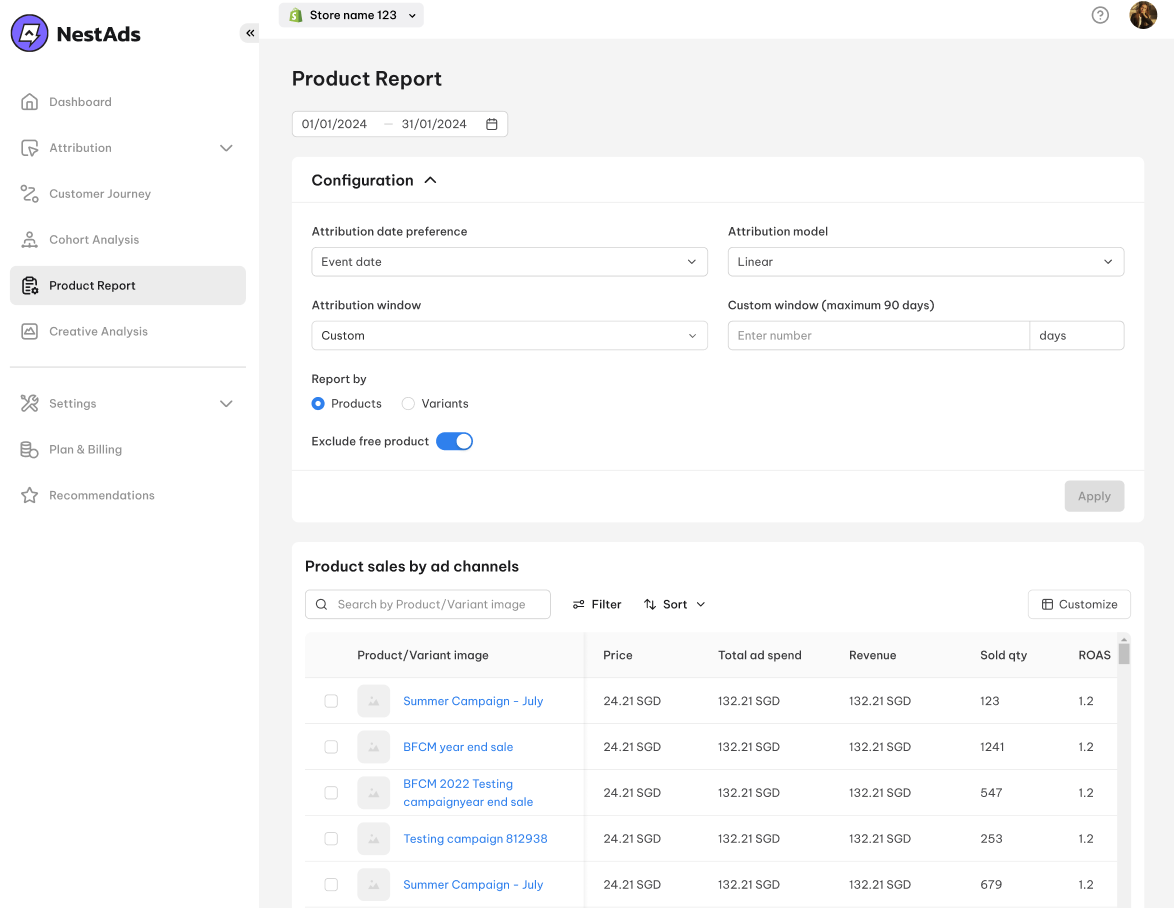
NestAds also features a highly functional product report, making it easy for brands with a large catalog to spot which products are converting and which aren’t.
DTC Value & Key Strengths
- Shopify-First: Offers a dead-simple installation tailored specifically to the Shopify ecosystem, bypassing technical code configurations.
- TikTok & Meta Creative Analysis: Breaks down ad creative performance on visual platforms, helping brands identify exactly which creatives win the most cart additions.
- Product Report: Identify high-converting products across ad campaigns; also spot underperforming ones that need more optimization.
- Affordable Pricing: Features a free tier and a low-cost, flat rate entry point that does not scale up with your revenue.
Limitations
- Restricted for brands running on custom frameworks, WooCommerce, or headless setups.
- Lacks advanced data extraction capabilities or predictive lifetime value modeling features.
Best For
Small-to-medium DTC Shopify brands that need basic, visual cross-platform ad performance tracking and creative analysis.
2. TrackBee

TrackBee is a first-party data collection and server-side tracking tool designed to fix broken data communication between your store and your ad accounts.
I chose TrackBee because it does not try to be a standard visual dashboard for business presentations. Instead, it acts as a backend data repair tool. TrackBee captures transactions that web browsers block and passes that enriched conversion information straight back to ad platform APIs. This directly helps your ad manager optimization algorithms find better customers and lower your acquisition costs.
DTC Value & Key Strengths
- Fixes Broken Pixel Matching: Operates completely server-side, logging browser-blocked transactions and passing enriched customer data back to Meta CAPI, TikTok Events API, and Google Enhanced Conversions.
- Lowers Real CPAs: By feeding clean, first-party data directly back into ad network algorithms, it trains platform AI to find higher-intent ecommerce shoppers, effectively lowering cost-per-acquisition metrics over time.
- Persistent Shopper Profiles: Stitches customer cross-device paths together from early click to final purchase, eliminating gaps when customers jump from mobile viewing to desktop buying.
Limitations
- Primarily fixes the backend data piping; it does not feature an executive finance dashboard or broad P&L view.
- Requires a solid, upfront understanding of API configurations during initial deployment.
Best For
Mid-market DTC brands scaling paid social spend whose main operational hurdle is missing conversion signals inside ad managers.
3. Rockerbox
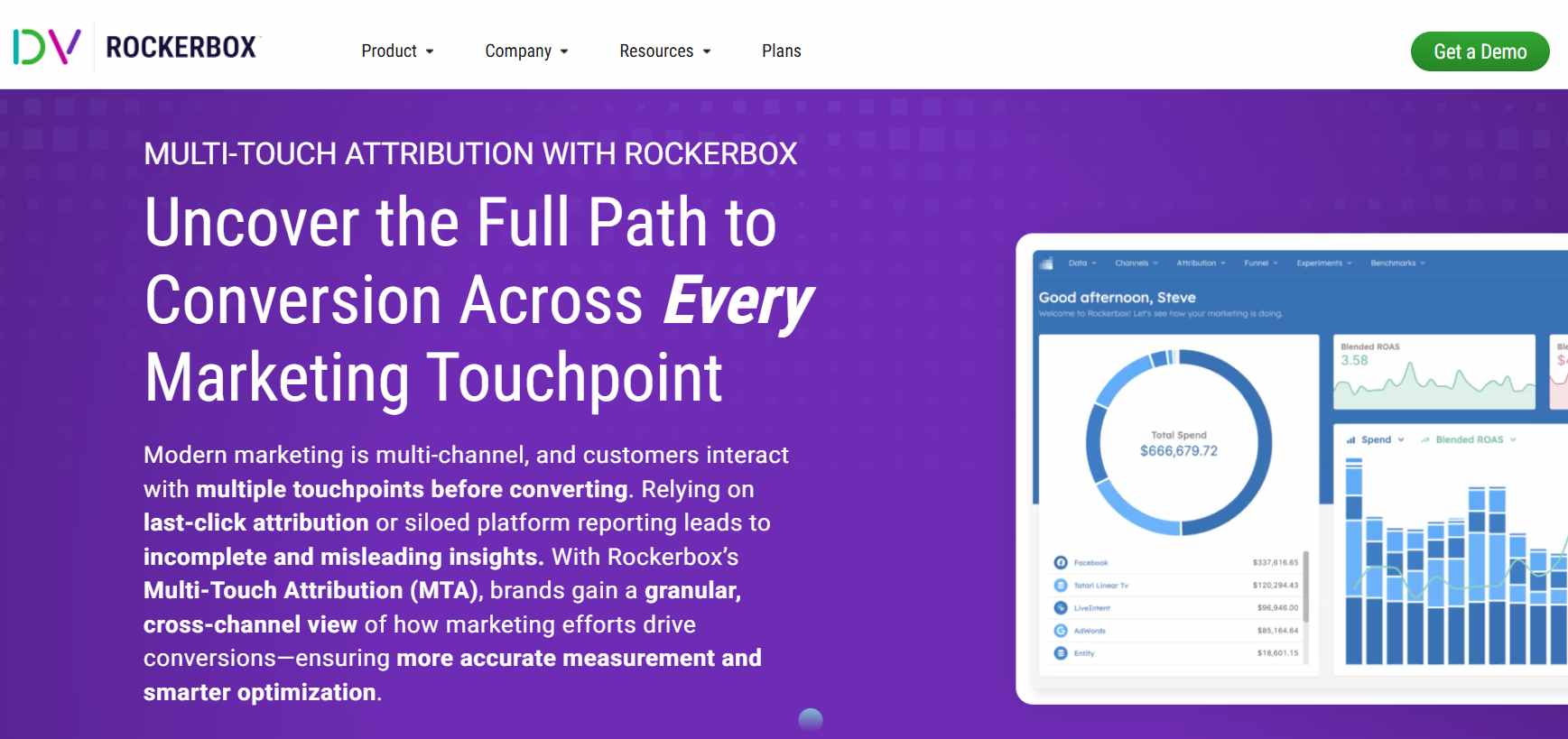
Rockerbox unifies expansive marketing campaigns for scaled DTC operations. It coordinates multiple online click paths alongside traditional physical media options.
Rockerbox stands out because it is built for multi-channel brands that grow beyond standard social media ads. While simpler tools only track web clicks, Rockerbox separates itself by pulling physical real-world marketing events (like direct mail, podcasts, influencer gifts, and television spots) into the exact same dashboard as your Facebook and Google metrics. It resolves conversion disputes by ensuring different ad networks do not claim credit for the exact same order, giving you a clear, single version of the truth.
DTC Value & Key Strengths
- True Omnichannel Pathing: Organizes overlapping marketing touches into a single visual tree, seamlessly accounting for modern digital paths alongside offline channels like podcasts, influencer campaigns, and linear TV ads.
- Eliminates Double-Counted Revenue: Resolves conflicts where both Meta and Google attempt to claim full credit for a single order, providing an unbiased single source of truth for the marketing director.
- Promo Code Tracking: Integrates offline promo codes directly into digital conversion paths to properly attribute word-of-mouth or creator-led scaling initiatives.
Limitations
- Designed heavily for the enterprise tier, requiring substantial ongoing monthly investments.
- Setup complexity often requires internal data analyst help to configure and run dashboard models accurately.
Best For
Scaled DTC brands running aggressive omnichannel budgets across diverse online and offline marketing avenues.
4. TrueProfit
TrueProfit changes your marketing conversations from top-line revenue tracking to true bottom-line profitability. It looks directly at your actual cash margins relative to live ad costs.
TrueProfit focuses on net profit instead of just ad revenue, linking your live ad clicks directly to your backend operational costs. It automatically pulls data from your store and shipping platforms to factor in your cost of goods sold, shipping fees, and payment gateway costs in real time.
DTC Value & Key Strengths
- Real Net-Profit Attribution: Automatically factors in cost of goods sold (COGS), multi-tier shipping costs, transaction gateway fees, and ad platform spend in real time.
- Product-Level Custom CAC Tracking: Shows the exact Customer Acquisition Cost (CAC) for individual SKUs and collection pages, warning brands if an ad campaign is successfully driving volume but burning actual cash margins.
- Automated Data Syncing: Pulls cost parameters straight from e-commerce platforms and shipping solutions (like ShipStation) without forcing teams to handle daily spreadsheet work.
Limitations
- Lacks deep, multi-touch algorithmic path configurations for long, high-ticket consideration windows.
- Highly focused on product transactional metrics over advanced, multi-month brand marketing models.
Best For
Inventory-heavy e-commerce stores that want to track real-time net profitability across every active ad account.
5. Fospha
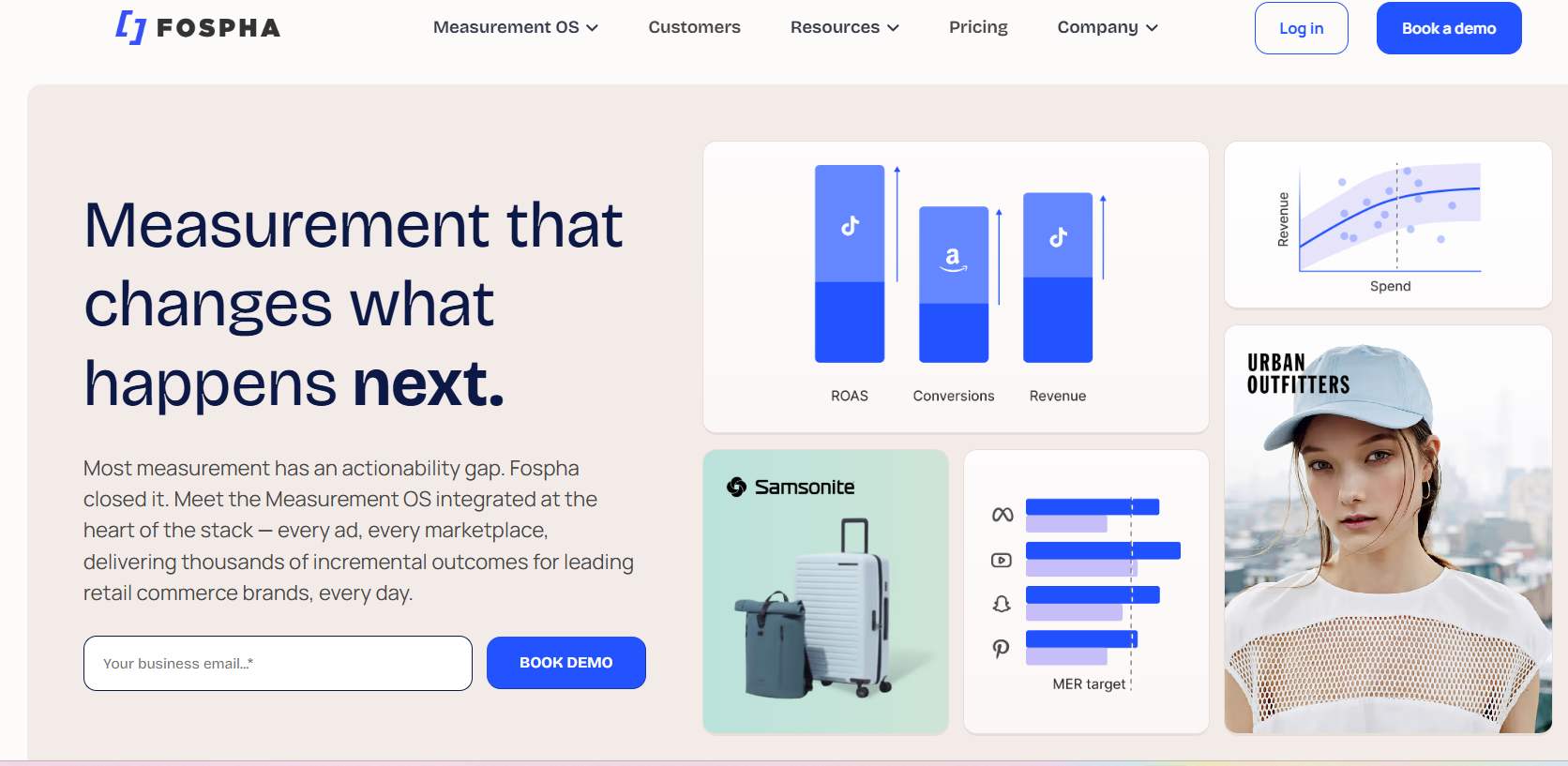
Fospha is a privacy-first marketing attribution platform that uses top-down statistical modeling to calculate your true channel performance.
Fospha operates without user-level tracking scripts or browser pixels, utilizing Marketing Mix Modeling (MMM) to analyze your overall spending trends and broad regional market movements. This design keeps your data completely immune to privacy updates, browser ad blockers, and tracking opt-out settings that frequently break standard pixel tracking.
DTC Value & Key Strengths
- Cookie-Independent Stability: Relies on top-down Marketing Mix Modeling (MMM) and impression-led methodologies, meaning privacy updates, iOS restrictions, and ad-blockers cannot degrade its data.
- Measures Upper-Funnel Lift: Accurately calculates the hidden revenue lift generated by top-of-funnel channels (like TikTok, Pinterest, or YouTube) that influence buying decisions without driving an immediate, traceable click.
- Zero Web Script Bloat: Requires no complex developer maintenance or heavy JavaScript snippets that can degrade web performance.
Limitations
- Does not track individual customer user profiles or reveal hyper-granular single-click events.
- Demands a significant baseline of historical transaction data, making it a poor fit for low-volume startups.
Best For
Large DTC brands that want to accurately value top-of-funnel social media influence without dealing with brittle tracking codes.
Further reading: Multi Touch Attribution vs Marketing Mix Modeling: How to Choose?
6. BillyGrace
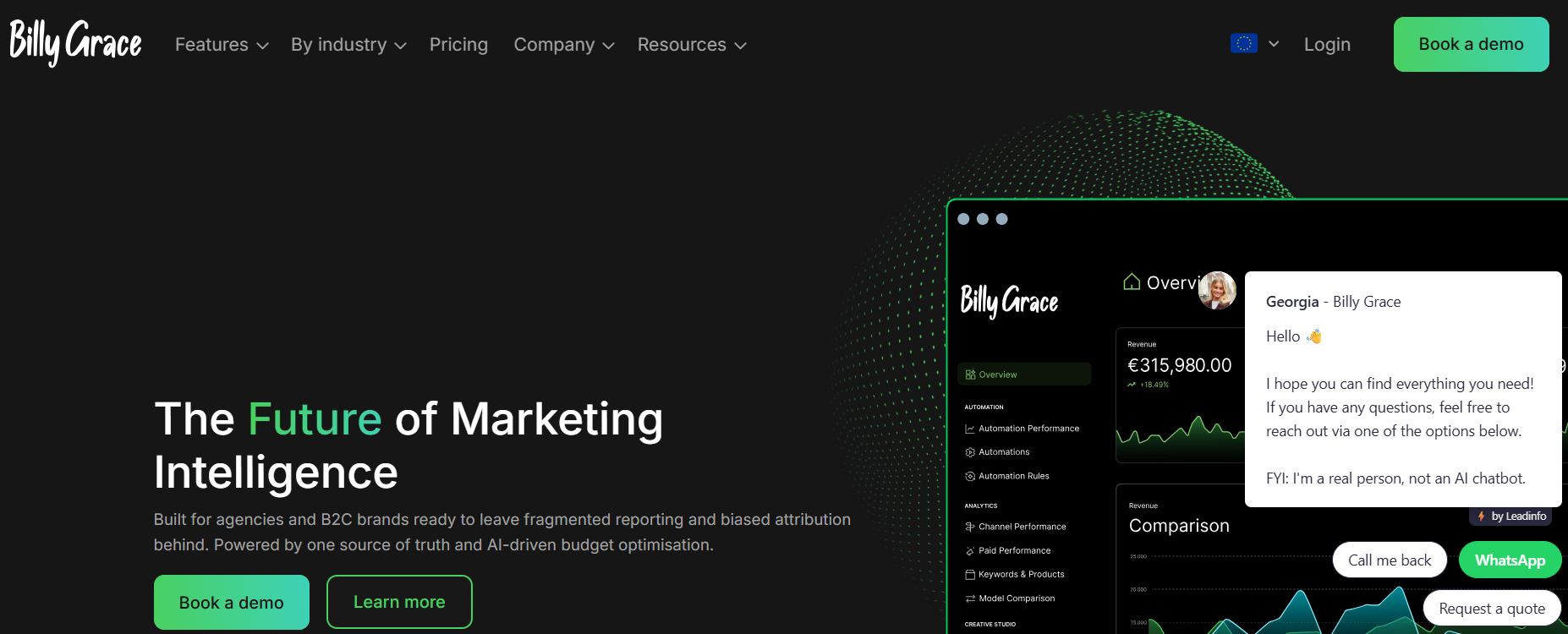
BillyGrace serves as both a central data attribution platform and an automated media buying partner. It translates tracking facts into direct, actionable optimization routines.
BillyGrace uses internal AI tools to actively execute budget optimization tasks. It looks at your cross-channel data from Meta, Google, and TikTok simultaneously, and can automatically shift spend into your winning campaigns based on rules you set up.
DTC Value & Key Strengths
- AI Budget Rebalancing: Evaluates cross-channel performance across Meta, Google, and TikTok simultaneously, providing direct, automated actions to move budget into winning channels.
- Lean Team Support: Acts as a force-multiplier for solo-founders or small internal marketing departments, freeing them from constant dashboard hopping.
- Cross-Channel Analytics: Consolidates multiple ad managers into a single, straightforward dashboard screen without requiring extensive data configuration training.
Limitations
- Turning over budget automation directly to an AI framework requires trust and careful initial guardrail tuning.
- Supported channels are primarily restricted to mainstream digital advertising platforms.
Best For
Fast-growing e-commerce brands with small marketing teams looking to automate cross-platform budget scaling choices safely.
7. Wicked Reports
Wicked Reports is a multi-touch attribution platform that specializes in tracking long-term customer cohorts and customer lifetime value (LTV).
Wicked Reports approaches marketing data with a deliberate, long-term perspective. While daily tracking tools focus strictly on what happened over the last twenty-four hours, this system specializes in customer journeys that span across months and seasons. It serves as the primary option for subscription-box brands and ecommerce stores that rely on repeat customer purchases because it links recurring revenue back to the original ad click.
DTC Value & Key Strengths
- Built for Subscription Models: Natively tracks recurring revenue streams, connecting subscription box sign-ups and long-term cohort values straight back to the original top-of-funnel marketing asset.
- Email Flow Attribution: Connects email marketing steps (like Klaviyo retention loops) to initial ad acquisition clicks, proving exactly how long-term email automation supports cold-traffic returns.
- First-Click Clarity: Pinpoints the early, educational content campaigns that initially introduced high-LTV customers to your store weeks before they purchased.
Limitations
- Reporting speeds are traditional and steady, making the tool ill-suited for day-to-day, hourly media-buying decisions.
- Demands incredibly rigorous, highly disciplined UTM tagging habits across all past and active ads to stay accurate.
Best For
Subscription boxes and DTC brands focused heavily on maximizing long-term customer retention and lifetime value data.
👉 Related:
How to Choose the Right Server-Side Tracking Tools for Your Store
How to Track User Journey for Different Channels Ads (2026)
Best Tools to Track Ad Performance Across Platforms (2026)
Shopify Server-side Tracking: How to Set Up & Best Practices
FAQs: DTC Attribution Tool
There is no single model that fits every business perfectly. If you sell low-ticket impulse items, a basic last-click model works fine. However, if you mix top-of-funnel channels like TikTok with bottom-of-funnel search ads, a position-based model is much safer. These balanced configurations give credit to the initial ad that sparked interest while also recognizing the final ad that closed the sale.
You should generally consider a dedicated tool once your monthly ad spend crosses $10,000 across multiple platforms. If you spend less than that or only run ads on a single channel, native platform pixels or free tiers will give you enough clarity. When you start scaling across two or more platforms, the cost of data duplication will quickly outweigh the subscription price of a tool.
Modern tools navigate privacy opt-outs by moving away from browser cookies and using first-party, server-side data extraction. When a customer makes a purchase, your ecommerce platform generates an internal invoice event. The attribution tool securely takes that server data and matches it to your historical ad clicks using first-party data points like email addresses, bypassing browser-level blocking entirely.