







 Ecommerce News
Artificial intelligence (AI) is changing how online stores operate. For small and medium-sized ecommerce businesses, AI tools offer a practical way to automate repetitive tasks, optimize marketing, and improve conversion rates without requiring a massive budget.
If you want to use this technology to improve your store performance, you need to understand how it works and where it applies. This guide answers the most common questions about AI in ecommerce clearly and directly.
Basics of AI in Ecommerce
1. What Are the Types of AI in Ecommerce?
Ecommerce platforms and marketing tools generally rely on three main types of artificial intelligence:
- Machine Learning: This technology analyzes historical customer data and purchase histories to identify trends. It helps you predict future sales demand and customer behavior.
- Natural Language Processing (NLP): This allows software to understand, interpret, and respond to human language. It powers customer service tools and sentiment analysis for product reviews.
- Computer Vision: This technology processes visual data. It enables features like visual search, where customers upload a photo to find a product, and automatic image tagging for inventory.
2. How Is AI Used in Ecommerce?
Merchants use AI across several areas of daily store operations to increase efficiency:
- Personalization: AI tracks on-site behavior to display relevant products to individual shoppers and send targeted email campaigns based on customer intent.
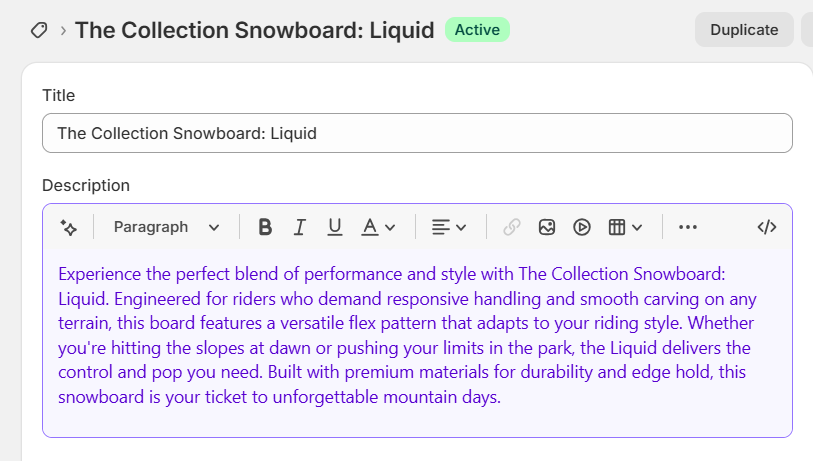
- Content Generation: Software automatically writes product descriptions, drafts email subject lines, and generates social media copy to save manual labor.
- Logistics: Predictive algorithms look at past sales trends to help merchants forecast inventory needs, optimize warehouse storage, and select the most cost-effective shipping routes.
- Conversational commerce: AI chatbots is one of the most commonly used AI system for online stores. It provides 24/7 customer support and recommend relevant products in seconds to boost AOV.
3. Which AI Is Best for Ecommerce?
There is no single best AI software because the right tool depends entirely on the problem you want to solve. Instead of looking for an all-in-one miracle tool, you should match your business needs to the right software type.
Here is a quick summary:
| Business Challenge | Recommended AI Solution | Examples |
|---|---|---|
| Spending hours writing product copy | Generative AI | ChatGPT, Gemini, Claude |
| High customer support ticket volume | Conversational AI | AI chatbots |
| Leftover inventory or stockouts | Predictive Analytics AI | Inventory management software |
| Low conversion rates on your site | Recommendation AI | AI sales agents |
AI Personalization FAQs
4. What Is AI Personalization?
AI personalization is the process of using customer data to deliver a tailored shopping experience.
Instead of treating every visitor the same way, companies use AI to show relevant product recommendations on their website and send targeted email marketing campaigns based on what a customer has viewed or purchased in the past.
By analyzing customer data — such as browsing history, demographics, and real-time behavior — brands can deliver highly tailored content to individuals at scale.
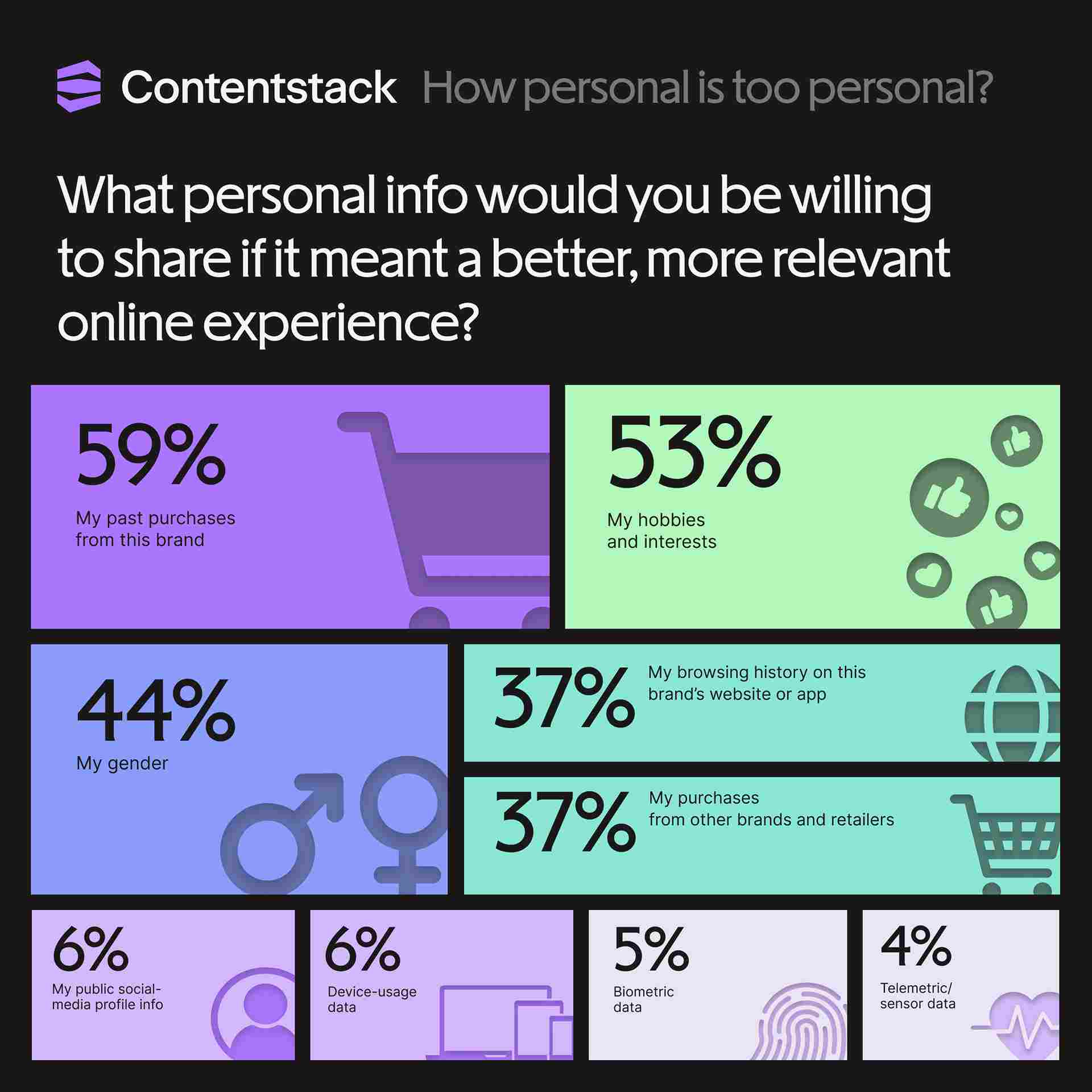
According to Contentstack, customers are willing to provide personal information for a better shopping experience:
5. How Is AI Transforming Personalized Marketing?
In the past, ecommerce marketing meant sending the exact same email blast to your entire subscriber list. AI completely changes this approach.
According to a comprehensive retail study by McKinsey & Company, companies that excel at personalization generate 40% more revenue from those activities than slow movers. AI achieves this by automatically segmenting your audience based on their behaviors, and allows brands to adopt:
- Dynamic Content: Websites and apps automatically show different layouts, banners, and messages based on what each visitor has viewed or done before.
- Personalized Product Recommendations: AI suggests products that shoppers are most likely to buy, such as “You may also like” or “Frequently bought together.”
- Predictive Advertising: AI analyzes customer behavior and interests to show ads to the right people when they are most likely to make a purchase.
- Automated Email Marketing: AI personalizes email timing, subject lines, and content for each recipient instead of sending the same email to everyone.
6. What Is the Future of AI Personalization?
The next phase of AI personalization moves away from basic product recommendation and enters the realm of predictive, hyper-individualized shopping experiences.
According to retail trend reports from Gartner, future systems will focus heavily on predicting consumer needs before a user explicitly initiates a search.
By analyzing continuous consumer habits, machine learning algorithms will forecast precise replenishment cycles for consumable goods, allowing brands to serve automated, targeted offers at the exact moment a customer runs low on a product.
Ultimately, the future of this technology lies in creating an invisible, frictionless journey where the store acts as an intuitive personal shopper, improving customer experience.
Conversational AI FAQs
7. What Is the Difference Between Conversational AI and Generative AI?
It is easy to confuse these two terms, but they have completely different jobs.
Conversational AI is built specifically to hold a helpful dialogue. Its main goal is to understand what a human is asking and guide them to the right solution.
Generative AI, on the other hand, is built to create entirely new content from scratch, whether that is a brand new product description, an image, or an email subject line.
8. Is Conversational AI the Same as Chatbot?
Not anymore. Traditional chatbots are rule-based, meaning they can only answer questions if the customer clicks a specific button or uses exact phrases.
Conversational AI uses natural language processing to understand context, recognize typos, interpret human intent, and hold natural conversations without breaking down when a user phrases a question poorly.
9. What Is an AI Sales Agent?
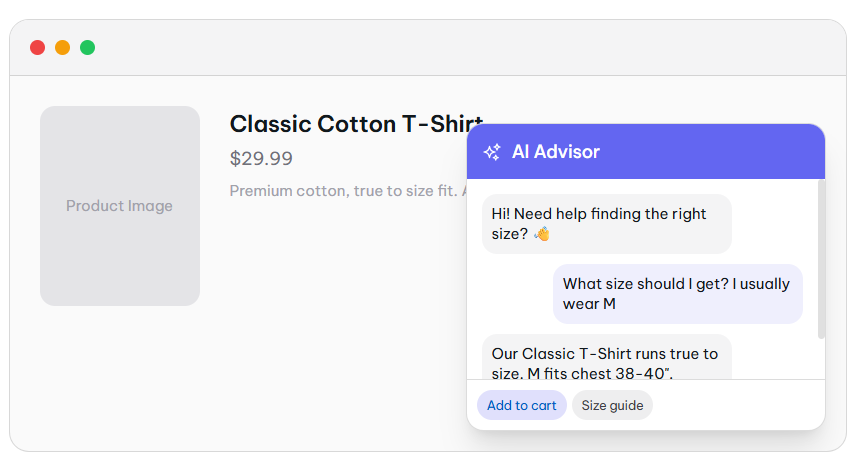
An AI sales agent is an advanced proactive AI tool that opens conversations and helps customers complete a purchase. Unlike support bots that only handle complaints, a sales agent interacts with users who are actively shopping.
If a user lingers on a checkout page, the AI sales agent can open a chat window to answer questions about sizing, clarify return policies, or provide a discount code to avoid a potential abandoned cart.
Further reading: AI Concierge in Ecommerce: Refining the Customer Journey
10. How Do You Automate Customer Support Conversations with AI?
You can automate your store’s customer support by following three straightforward steps:
- Integrate an AI sales agent: Choose an AI support tool that connects directly to your platform so it can check order statuses and shipping data.
- Upload documentation: Provide the tool with your FAQ pages, store policies, and historical support tickets so it can learn correct answers.
- Create a human handoff rule: Ensure the software instantly routes complex questions or escalated issues to a live support agent.
AI Content Generation FAQs
11. What Can AI Content Generation Do?
Generative AI helps you create creative assets and marketing materials at scale. For a growing online store, this technology eliminates manual bottlenecks across several creative workflows:
- Brainstorm ideas: You can instantly get hundreds of new ideas. AI can also expand your own creative sphere based on its massive data.
- Write bulk product descriptions: You can input raw product data sheets or basic dimensions, and the AI will generate unique, engaging descriptions for hundreds of items simultaneously.
- Edit and enhance product imagery: You can use AI to remove messy backgrounds from your product photos, replace them with clean studio settings, upscale blurry images, and generate seasonal lifestyle backdrops.
- Draft marketing campaigns: AI can instantly write email newsletters, create catchy email subject lines, script promotional text messages, and draft social media captions for Instagram or TikTok.
12. Which AI Can Generate Content?
Content generation is handled by Generative AI models. These systems are trained on massive amounts of text and media data, which allows them to understand grammar, tone, and visual styles to create human-like outputs on demand.
Here are the most common Generative AI tools:
- ChatGPT (OpenAI): This is a highly versatile tool that offers a powerful free tier. It is excellent for brainstorming ideas, drafting daily customer service emails, or writing standard product descriptions.
- Claude (Anthropic): This platform is known for its natural, human-like writing tone. The free version is highly effective at refining your brand voice, editing existing drafts, and writing long-form blog content.
- Google Gemini: This tool connects directly to Google’s search engine, allowing the free version to access real-time information. It is useful for conducting quick competitor research and analyzing current market trends.
13. What Are the Risks of Generative AI?
While generative AI saves time, relying on it blindly can introduce serious risks to your business. Online merchants need to monitor these tools closely to protect their brand reputation:
- Inaccuracies: AI models do not actually know facts; they predict the most likely next word. This means they can completely invent fake product specifications or false company history that looks entirely realistic.
- Generic Brand Voice: If you use AI outputs without editing them, your content will sound exactly like every other competitor using the same prompts.
- Duplicate Content Issues: Because AI models are trained on existing web data, they often generate highly repetitive phrasing. Without editing, search engines may flag your text as duplicate content, which can hurt search rankings.
- Copyright and Data Privacy Concerns: Any sensitive data you type into free AI tools, such as private supplier lists or customer data, can be used to train future public models.
Overall, companies should use public generative AI tools with caution.
AI Visibility for Brands FAQs
14. What Does AI Visibility Mean for Brands?
In the past, SEO was all about ranking at the top of a Google search results page. Today, consumers are using tools like Google AI Overviews, ChatGPT, and Perplexity to find product recommendations.
AI visibility means optimizing your online store so these AI engines find, trust, and recommend your products inside their AI-generated summaries. It is a brand new branch of digital marketing often called Generative Engine Optimization (GEO).
Relevant reading: How People Are Using AI for Shopping
15. What Is the Best AI Visibility Platform?
There is no single platform that controls AI visibility. The best case scenario is that your brand is mentioned across all AI engines.
Established SEO suites like Semrush allow you to track your presence in modern search features and analyze how often your brand appears in AI-generated summaries. Managing your visibility requires a mix of traditional keyword research and optimized product data feeds.
16. How Do You Increase Your Brand’s AI Visibility?
AI engines recommend products that they can easily verify through reliable data. You can improve your visibility by following three main principles:
- Use structured schema markup: Add clean product schema to your website code so AI crawlers can instantly verify your price, availability, and product details.
- Write clear, direct answers: Structure your product pages and blog content to answer common buyer questions concisely without using fluff or overly complex language. Just like this FAQs-style article.
- Build authoritative third-party reviews: AI tools pull data from across the web, meaning positive reviews on platforms like Reddit, Trustpilot or Google Business improve your credibility with AI models.
👉 Related:
AI Agent vs Chatbot: Key Differences You Need to Know
Additional FAQs
Shopify has heavily invested in making AI accessible to small merchants through its native suite of tools called Shopify Magic. According to official feature rollouts on the Shopify platform, merchants can use built-in AI to instantly generate product descriptions, edit product image backgrounds directly from the media manager, and write automated email marketing campaigns.
For most small to medium businesses, yes, AI is absolutely worth the investment. The key is to evaluate the return on investment based on time saved and error reduction rather than just immediate sales growth.
If a twenty dollar per month AI tool saves you ten hours of manual copywriting every single week, it has already paid for itself many times over. Start with free or low-cost tools to automate your biggest bottlenecks before moving on to expensive softwares.
Yes, the SEO landscape has evolved rapidly. There are now specialized AI tools built to automate the generation of missing meta titles and optimize category page descriptions at scale. If you are using Shopify, you can optimize GEO and AI visibility with third-party apps.