







 Ecommerce News
Ecommerce ad tracking is difficult in 2026. Privacy updates and browser restrictions make it hard to see which ads actually drive sales; also, you are probably running ads on multiple platforms. Many merchants look to tracking software to solve this issue, and Triple Whale is one of the most popular data attribution tools on the market.
Is Triple Whale actually worth the investment for your business? This review looks directly at the features, real costs, and alternatives to help you make an informed decision.
💡 Key Takeaways
- How does Triple Whale work? Triple Whale uses first-party server-side tracking to capture sales data directly, which bypasses modern browser privacy blocks and data drops.
- How much is Triple Whale? The platform uses a variable pricing structure based on your store’s GMV, with base plans ranging from $219/month to over $1000/month.
- Is Triple Whale worth the cost? The software is worth the investment for established ecommerce brands making over $500k in annual revenue across multiple ad networks, but the variable costs make it a financial risk for small-to-medium stores.
- Best Alternative: NestAds serves as a top alternative for Shopify DTC merchants and agencies by offering full multi-touch server-side attribution for a flat price of $129.99 per month.
What is Triple Whale and How Does It Track Ads?
Triple Whale is a data centralization platform built for e-commerce brands. It integrates with your ecommerce store and your advertising channels to aggregate your marketing data into a single dashboard.
Triple Whale bypasses browser limitations by using first-party, server-side tracking. Instead of relying on the user’s web browser to report a sale, the software tracks data directly through your Shopify server.
Here is a summary of how Triple Whale collects your data:
- Server-Side Integration: It connects directly to your Shopify backend to track transactions at the server level.
- First-Party Click Identifiers: It assigns anonymous tracking IDs to users when they click your ads.
- Multi-Channel Aggregation: It pulls data via official APIs from Meta, Google, TikTok, and Pinterest into one dashboard.
Triple Whale: Cost vs. Return on Investment (ROI)
An ad tracking tool must generate a clear financial return. For most ecommerce businesses, the ROI comes directly from reducing ad waste.
If your ad platforms show conflicting data, you might scale a losing campaign or turn off a profitable one. Accurate tracking helps you distribute your ad budget efficiently.
However, your actual return depends heavily on your monthly software costs. You must evaluate how the pricing structure impacts your profit margins.
Triple Whale Pricing Overview (2026)
Triple Whale uses a variable pricing model based on your store’s Gross Merchandise Value (GMV). As your store revenue increases, your monthly subscription fee rises.
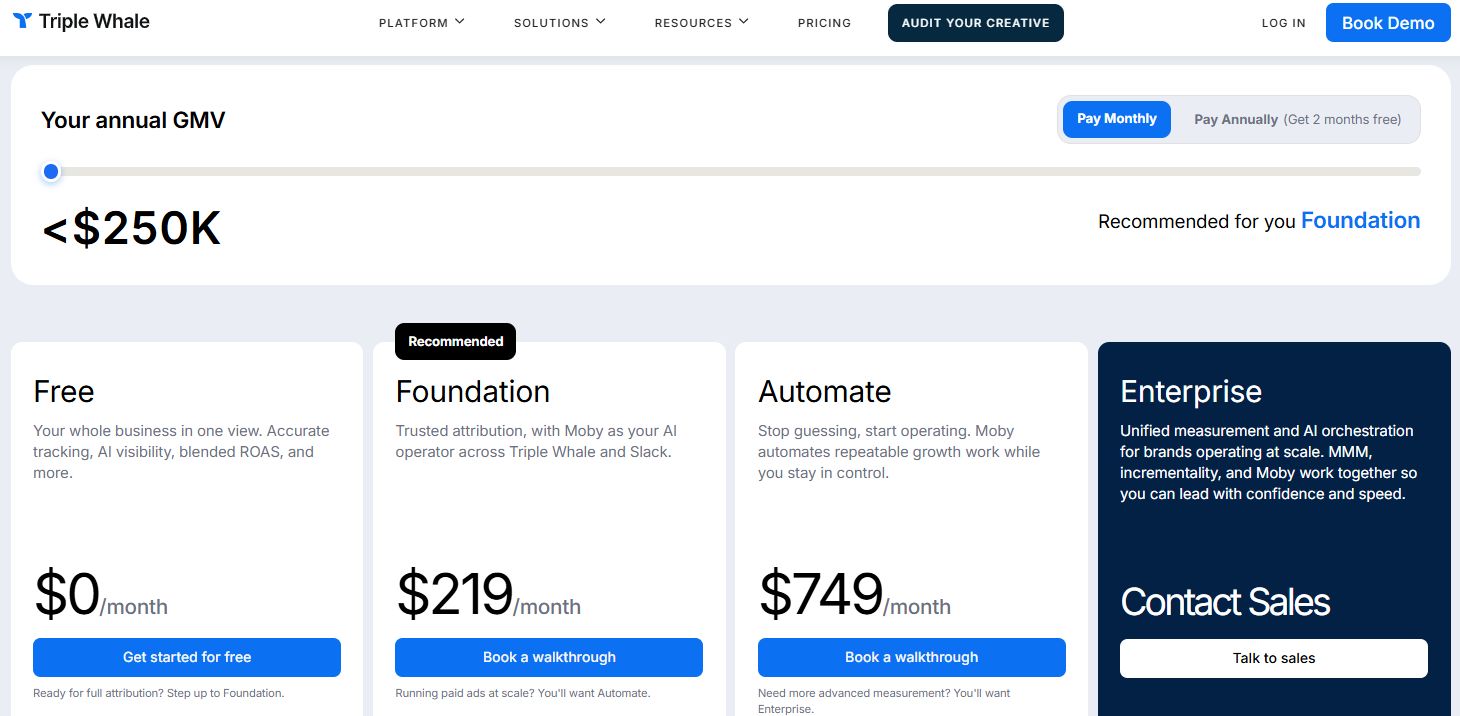
Let’s take a look at my summary table of Triple Whale Pricing:
| Pricing Plan | Base Cost (Monthly) | Key Features Included | Plan Limitations & Target |
|---|---|---|---|
| Free | $0 / month | Blended data aggregation, First-click and Last-click models, standard post-purchase surveys. | No multi-touch pixel attribution. Limited to a 12-month data lookback window. |
| Foundation | Starts at $219 / month | Multi-Touch Attribution via Triple Pixel, unlimited users, unlimited lookback, ad budget management tools. | Excludes creative analytics, product cohort reporting, and custom dashboards. |
| Automate | Starts at $749 / month | Everything in Starter, plus creative analytics, product analytics, cohort analysis, and a no-code dashboard builder. | A huge price jump from the Foundation plan |
| Enterprise | Contact Sales | Everything in Advanced, plus Marketing Mix Modeling and unlimited custom dashboards. | Highest baseline operational expense. Intended for large omni-channel scaling brands. |
Who is the Triple Whale Free plan for?
The Triple Whale Free pricing plan is suitable for new stores or beginners who want to view their baseline data in one place without a monthly subscription fee. It costs $0 per month, making it a risk-free choice to get familiar with the platform layout.
The Free plan offers a basic centralized dashboard that pulls your standard marketing channel numbers together on a single screen.
With the Triple Whale Free plan, you can get access to basic data compilation tools, including:
- Blended data aggregation from your connected marketing channels
- First-click and Last-click attribution models
- Standard post-purchase surveys for your customers
From my point of view, the major downside of this pricing plan is that it lacks the true server-side Triple Pixel multi-touch attribution. It also limits your data lookback window to only 12 months, which makes it difficult to run year-over-year performance reviews.
To summarize my thoughts, Triple Whale’s Free plan is not really necessary, as it can be easily done with Google Analytics or your native ad dashboards. If you are going for Triple Whale, you should start from the Foundation plan.
Who is the Triple Whale Foundation plan for?
The Triple Whale Foundation pricing plan is suitable for growing ecommerce businesses that need reliable, first-party tracking to counter browser privacy restrictions. The monthly subscription fee starts at $219 for stores in the baseline revenue brackets (under $250k annual GMV).
Yes, Triple Whale’s pricing will scale a lot with your annual GMV, and you can check your pricing on Triple Whale’s official pricing page.
With the Triple Whale Foundation pricing plan, you can get access to core tracking tools, including:
- Multi-touch attribution powered by the server-side Triple Pixel
- Unlimited user accounts for your team or agency partners
- Unlimited data lookback history
- Integrated ad budget management tools
From my point of view, the downside of this pricing plan is that it completely excludes creative analytics, product cohort reporting, and advanced custom dashboards. You cannot see exactly which ad image or video performs best, which is a major limitation for visual ad platforms.
To summarize my thoughts, the Foundation plan is a great choice for brands that want to fix their attribution gaps and get a consistent reporting platform. However, the operational cost is unpredictable, and can scale up aggressively as your business grows. Whichever plan you choose, I suggest you take more time to calculate an estimated cost for Triple Whale based on your annual GMV, and see if the cost is justified.
Who is the Triple Whale Automate plan for?
The Triple Whale Automate pricing plan is best for large, scaling ecommerce brands and marketing teams that rely heavily on testing ad creatives. The subscription fee starts at $749 per month for baseline revenue brackets.
The Automate plan provides you with deep analytical tools to optimize your ad spend based on creative assets and product performance.
With the Triple Whale Automate pricing plan, you can get access to advanced optimization features, including:
- Everything included in the lower Foundation plan
- Advanced creative analytics to track asset profitability
- Product analytics and customer cohort behavior tracking
- A flexible no-code custom dashboard builder
From my point of view, the downside of this pricing plan is the steep price jump from the previous tier. There is a clear differentiation between this plan and the Foundation plan; you should only use this Automate plan if you are managing a huge ads library, running creatives on multiple ads channels and need a dedicated creative analysis tool.
To summarize my thoughts, the Automate plan is a highly powerful tier for serious direct-to-consumer brands that need to know exactly which creative assets drive their margins. The higher cost is justified if you are a large, established brands that need scaling.
Who is the Triple Whale Enterprise plan for?
The Triple Whale Enterprise pricing plan is built for high-volume, multi-channel brands and large marketing agencies. This tier requires you to contact sales directly for custom pricing tailored to your specific operational volume.
The Enterprise plan offers a complete, tailored data infrastructure to handle complex omni-channel campaigns and custom data modeling.
With the Triple Whale Enterprise pricing plan, you can get access to the full platform capabilities, including:
- Everything included in the Advanced Automate plan
- Native Marketing Mix Modeling (MMM) for cross-channel testing
- An integrated developer SQL editor for custom database queries
- Unlimited custom dashboards and dedicated account support
The Enterprise plan is an elite solution meant strictly for large corporations that manage massive budgets across both digital and traditional media channels. It provides total data ownership if your brand has outgrown standard attribution platforms.
Is Triple Whale Worth It?
To determine if Triple Whale is worth the cost, you must look closely at your store’s financial structure. While the data is accurate, the pricing model introduces several operational risks.
Consider these four factors before purchasing:
- Revenue growth can trigger higher software costs: As your store grows, Triple Whale may become more expensive even if your team is using the same features.
- Add-ons can raise the real monthly price: Retention, Conversion, Compass, Data Warehouse Sync, and Moby Concierge can all increase the cost beyond the base plan.
- Advanced features may be overkill: Marketing mix modeling, incrementality testing, warehouse sync, and custom analytics are useful, but many ecommerce merchants do not need all of them.
- Pricing is harder to forecast: As GMV, data needs, and add ons change, the monthly bill can become harder to predict.
In conclusion, Triple Whale is highly valuable for established Shopify stores that manage complex ad budgets across three or more paid channels.
It is generally not suited for small-to-medium brands, or stores with tight net profit margins. If your business requires stable, predictable monthly software expenses, the variable GMV pricing model can become a significant issue.
Why NestAds is the Better Choice for DTC Shopify Merchants and Agencies
If you want an accurate, less expensive ad tracking tool, you should look at alternative options.
NestAds is a top Triple Whale alternative built specifically for Shopify merchants.
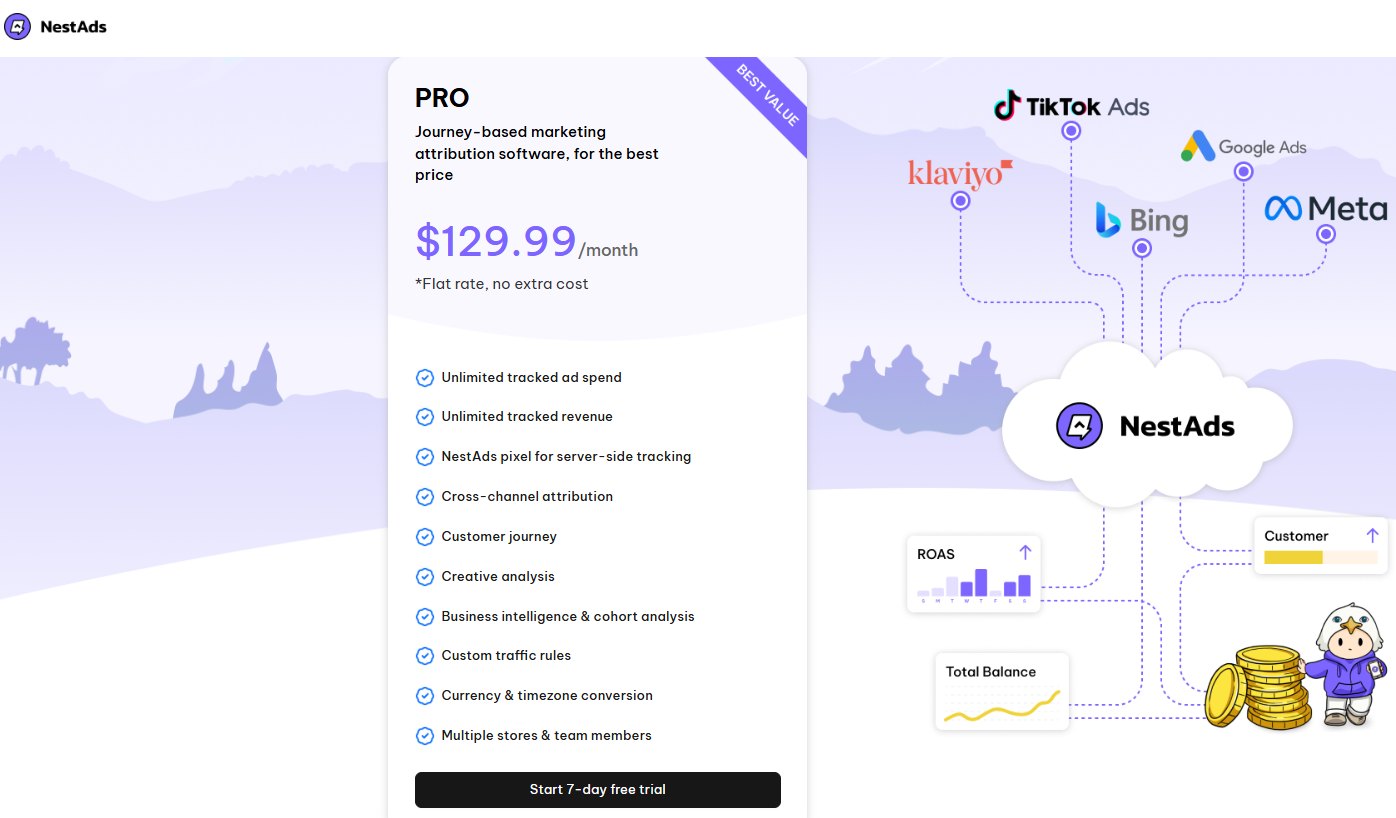
Unlike platforms that increase their rates when your sales grow, NestAds uses a transparent pricing model. The Pro plan costs a predictable, flat rate of $129.99 per month. This flat-rate structure gives growing brands several clear benefits:
- Unlimited tracked ad spend
- Unlimited tracked revenue
- Server-side tracking: You get full access to first-party server tracking to bypass iOS privacy restrictions safely.
- Multi-touch attribution: You can analyze first-click, last-click, and linear customer journeys to see exactly how your ads work together.
- Customer journey tracking & creative analysis
- Agency-friendly setup: Agencies can easily manage multiple client store views from a single dashboard without dealing with complex billing adjustments.
NestAds delivers the essential tracking features you need to scale your store profitably. It gives you clear creative analysis and reliable business data while keeping your software overhead fixed. Get started for free or book a live demo to see NestAds in action.
FAQs: Triple Whale & Alternatives
No. No software tool can restore 100% of lost tracking data. Triple Whale and most server-side tracking tools can significantly improve your data accuracy by using first-party server data instead of web browsers. This gives you a much clearer picture of your marketing performance, but it must still comply with global privacy rules and user-level opt-out choices.
Your choice should depend on your scaling needs and budget. NestAds is the best option for Shopify brands and agencies that want reliable multi-touch attribution for a fixed monthly price. Large enterprise companies spending massive budgets across both digital and traditional media often look at high-end systems like Northbeam. If you are a brand-new store with limited budget, you should stick with the native Shopify Analytics dashboard and a free, correctly configured Google Analytics 4 account.