








When we talk about a hook, we are talking about the first few seconds of your Instagram Reel or TikTok video. As the name suggests, your hook needs to grab your audience’s attention and compel them to keep watching.
In this guide, I will explain what hook rate is, how to track it, what benchmarks to aim for, and six practical ways to increase your hook rate on TikTok and Instagram Reels.
What is hook rate?
Hook rate is the percentage of viewers who stop scrolling and watch at least the first three seconds of your video. It tells you how effectively your opening visual, sound, or headline pulls a viewer out of passive scrolling so they give your content a chance.
Here is the formula to measure video hook rate:
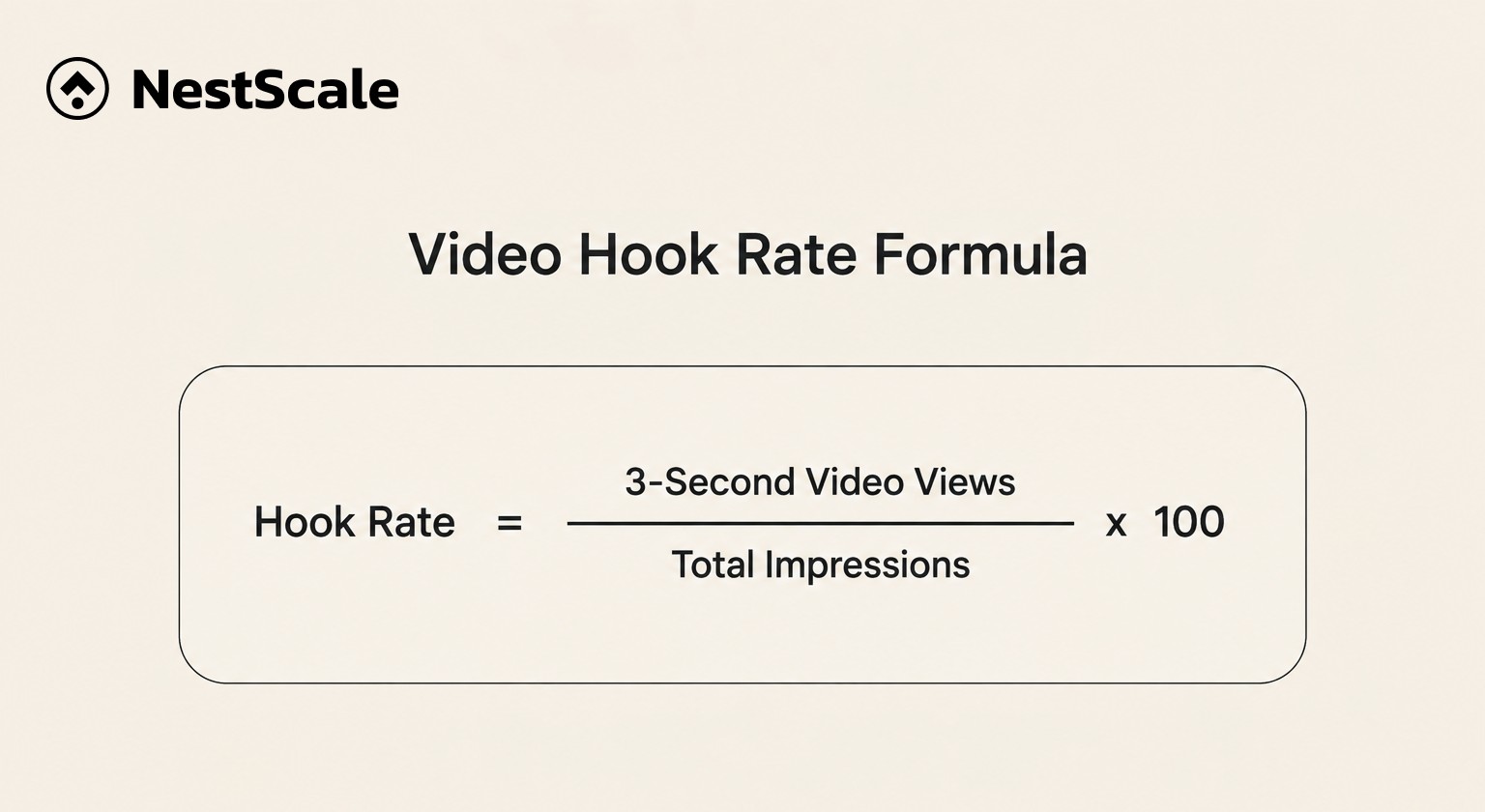
For example, if 1,000 people see your video in their feed and 300 of them watch for at least three seconds, your hook rate is 30%.
How Platforms Rank Your Videos Using Hook Rate
When you publish a new video, platforms like TikTok and Instagram do not show it to everyone at once. They show it to a small initial test group.
According to TikTok’s algorithm, early watch time and completion rates are key signals for content distribution. If viewers watch the first three seconds, the system recognizes that the video is engaging and shows it to a larger group of people. If viewers scroll away right away, the platform slows down or stops pushing the video.
In short, a strong hook rate unlocks the door to broader organic reach before the algorithm ever evaluates the rest of your video.
Read more: How to Calculate and Boost TikTok Engagement Rate (7 Ways)
What is a good hook rate? (Industry Benchmarks)
Comparing your performance to general benchmarks helps you know if your hooks are working well.
| Hook Rate Range | Performance Level | What It Means |
| Under 20% | Below Average | Most viewers scroll past quickly. The opening needs changes. |
| 20% to 35% | Average | Standard performance for most creator accounts. |
| 35% to 50% | Good | Strong retention that helps your video reach more people. |
| Over 50% | Excellent | High viewer interest with great potential for wide reach. |
Also:
- Benchmark reports from creative analytics platform Motion indicate that the overall average hook rate across short-form video ads is roughly 25% to 30%, while top-performing creative variations regularly reach 40% to 50%.
- Performance data from NestScale also shows that clear text overlays and physical motion in the first two seconds see up to a 50% lift in 3-second view retention compared to static openings.
If your hook rate is currently below 20%, you do not need to re-record your whole video. Usually, making minor updates to the first three seconds will lift your numbers.
Tracking this metric is valuable for anyone building an audience. Research from the Pew Research Center shows how popular short form video platforms remain across adult demographics. Having a clear hook ensures your message gets heard.
How to track and analyze your hook rate
You can easily find your retention metrics inside the native analytics of each app.
Tracking hook rate on TikTok
- Open TikTok, go to your profile, and select TikTok Studio.
- Tap Analytics and go to the Content tab.
- Tap an individual video and view the Retention Curve to see the percentage of viewers remaining at 3 seconds.
Tracking hook rate on Instagram Reels
- Open your Instagram profile and go to your Professional Dashboard.
- Tap Account Insights and select Reels.
- Select a video and look at the Retention graph under the watch time section.
If you run paid campaigns, you can also set up custom columns in Ads Manager by reviewing video metrics in the Meta Business Help Center.
5+ Proven Ways to Increase Your Hook Rate on TikTok & Reels
Here are six straightforward strategies you can apply to keep viewers watching your videos past the three second mark.
1. Use the “pattern interrupt”
A pattern interrupt is a simple action that breaks a viewer out of their scrolling routine.
When people scroll through their feed, their thumbs move automatically every second or two. If your video starts with you standing completely still, it looks like every other video in their feed.
Doing something quick and unexpected in frame one helps pause that scrolling habit. You can walk into the frame instead of starting in place, lean slightly toward the camera, or hold a physical object up to the lens before pulling it back to speak. These small movements encourage the viewer to pause long enough to hear your message.
2. Start with a clear premise
Viewers decide quickly whether a video is worth their time. If you take five seconds to introduce yourself, people will scroll away before you get to the point.
Tell viewers what the video is about in the very first sentence. Skip phrases like, “Hey guys, today I wanted to share a quick thought with you.”
Instead, state your topic directly: “Here is the simple weekly posting schedule I use to get new business clients.” When viewers know what value they will get, they are much more likely to stay tuned.
You can learn viral hooks for TikTok videos and Reels.
3. Ask an open-ended question or address a pain point
Opening with a clear problem or question immediately signals to your target audience that the video is meant for them.
When you mention a challenge your audience deals with, it triggers curiosity and encourages them to listen for your solution.
Here are a few quick copy examples you can adapt:
“Are you making this common tax mistake on your quarterly reports?”
“Is your store getting website visits but no sales?”
“Why do most workout plans fail after two weeks?”
These examples identify a specific group of people right away, helping you connect with the exact audience you want to reach.
4. Use trending sounds
Sound plays a major role in holding attention. When viewers recognize a popular sound or voiceover, it gives them an immediate reason to stay engaged.
You do not need to dance or do anything complex to use audio effectively. You can play a popular background track at a low volume beneath your spoken audio. Adding simple sound effects, like a quiet pop or a click when text appears on screen, also keeps the opening frames visually and auditorily engaging.
5. Show the end result first
If you are sharing a tutorial, a project, or a recipe, do not save the final reveal for the end of the video. Showing the finished product first creates instant interest.
If you are showing how to make a meal, start the video with a one second shot of the completed dish. After showing the result, cut directly to the first step of your process. Showing the final outcome up front builds anticipation and gives viewers a reason to watch how you created it.
6. Show real face and authentic setup
People connect with real human faces. An authentic setup often performs better than an overly produced video that looks like a formal commercial.
Look directly into the camera lens, speak naturally, and keep your setup simple. Avoid long greetings or formal intros at the start. Jumping straight into your topic with a natural tone builds quick trust with your audience.
FAQs about Hook Rate
While platforms measure your hook rate at the 3-second mark, your initial visual or spoken hook should happen in the first 1 to 1.5 seconds. Viewers make fast decisions while scrolling, so catching attention quickly keeps them from scrolling past.
Yes. If a video performed poorly because of a slow start, changing just the first two or three seconds and posting it again is a great way to test new openings. A faster start can significantly improve your results on the second attempt.
For Facebook Ads, a good hook rate generally sits between 25% and 35%, while top-performing ad creatives in highly competitive niches frequently achieve retention rates of 40% or higher within those critical first three seconds of total play time.
Across organic short form video feeds on TikTok and Instagram Reels as well as paid social campaigns, the industry average hook rate typically hovers between 20% and 25% for most standard accounts.




 Facebook Advertising
  TikTok Advertising