







Social commerce has changed how people buy products online. Instead of directing shoppers to an external website, social platforms now let customers purchase items directly inside the app. This guide breaks down how social commerce works in 2026, the key statistics behind its growth, main platforms to consider, and practical ways to use it for your business.
What is social commerce?
Social commerce is the process of selling products directly within a social media application. The entire transaction, from discovering an item in a video to choosing product options and making a payment, takes place without leaving the app.
In short, a whole customer journey can begin and end on social platforms.

When you use social commerce, you remove the extra steps usually required to buy online. Customers do not need to click an external link, wait for a website page to load, or manually type in their shipping information. Everything is handled within the social app using stored payment details and saved addresses.
The dominance of authentic branding & UGC
Consumers today are increasingly skeptical of hyper-polished corporate marketing, preferring real human experiences and genuine brand values. User-Generated Content (UGC) — including unboxing videos, customer reviews, social media posts, and community discussions — has transformed from a nice-to-have tactic into a core growth driver.
Brands now want to appear approachable to their targeted audiences. They create mascots, memes, reply to comments and post on social media daily. This helps them stand out in crowded markets and foster customer loyalty. To summarize:
- Brand authenticity: Modern audiences value relatable, imperfect content over staged ads. Seeing real people use and endorse a product creates immediate social proof and lowers buying friction.
- Cost-effective content creation: Leveraging community-led content allows brands to scale their media library continuously without relying solely on expensive productions.
- Algorithmic advantage: Recommendation engines on platforms like TikTok, Instagram, and YouTube favor engaging, relatable content, making UGC one of the most effective tools for organic reach.
The state of social commerce in 2026
Buyer habits have shifted noticeably toward native in-app shopping over the past few years. Recommendation algorithms now present products based on your viewing habits, matching relevant items to your interests while you scroll.
- Global market value: The global social commerce market has reached over 1 billion dollar in 2025, and is projected to grow to USD 1,9 billion in 2026.
- Primary product discovery: Market tracking from eMarketer shows that over 60% of online consumers now start their product search on social media rather than traditional search engines.
- Monthly buyer frequency: Data published by Statista reveals that nearly two-thirds of active social media users now complete at least one native purchase directly inside a social app each month.
This shift means social media is no longer just a channel for building brand awareness or generating website clicks. It has evolved into a primary retail storefront where millions of consumers browse and buy every day.
Key benefits of social commerce
Setting up a social storefront offers several distinct practical advantages over relying solely on a traditional ecommerce website.
- Higher conversion rates
- Faster product discovery
- Lower customer acquisition costs
- Community engagement
Higher conversion rates
Standard websites often lose potential sales when the checkout process takes too long or requires multiple steps. Cart abandonment frequently happens when users are redirected away from their social feed to an unfamiliar web page.
In-app shopping solves this problem by consolidating the social media touchpoints. When users discover a product through a video, they can view that product and make the purchase right away with built-in features. This helps greatly increase social media conversion rate compared to a static website.
Faster product discovery
Traditional ecommerce usually depends on a customer already knowing what they want to search for. Social commerce operates differently by using platform algorithms to introduce relevant products to users based on their viewing habits and interests.
Algorithms analyze user engagement to surface video reviews and product demonstrations in main feeds. This allows shoppers to discover useful items naturally while browsing content, which means small accounts with good video hooks can go viral overnight.
Lower customer acquisition costs
Paid advertising costs on digital channels can place a heavy burden on marketing budgets. Social commerce helps balance these costs by making organic video content directly shoppable.
When you tag products in short videos or user-generated content, every view serves as a potential sales opportunity. This is actually true for short-form video platform such as TikTok, where people buy something based on impulsive interest.
Community engagement
Unlike traditional ecommerce websites where shopping is a solitary task, social commerce makes buying interactive and collaborative. Shoppers can ask questions in real time during live streams, share product posts with friends, and leave video feedback directly on product tags.
This active participation turns single transactions into active discussions around your brand. When potential buyers see real people commenting on product fit, sharing unboxing videos, and answering each other’s questions, it builds strong social proof and turns casual viewers into followers or repeat customers.
Top social commerce platforms and how they work
Each social network offers different tools for native selling. Understanding how these features function helps you pick the right platform for your audience.
TikTok
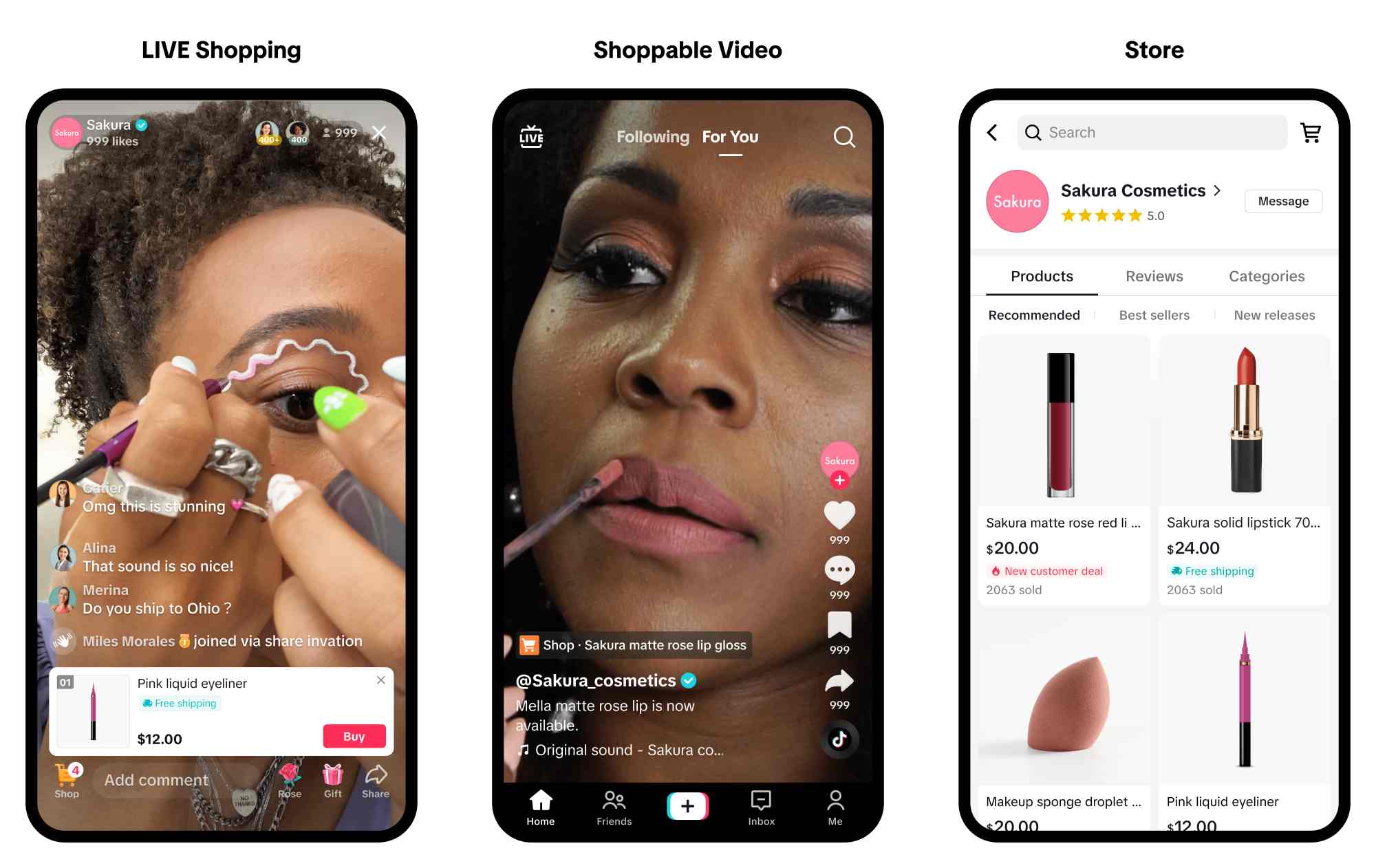
TikTok Shop allows sellers to attach clickable product tags directly to short videos, live streams, and a dedicated store tab on their profile.
When a viewer watches a product video, a small link appears near the bottom of the screen. Tapping this link opens a product detail menu where the buyer can select sizes or colors and complete the order. Merchants can manage their inventory, track orders, and set up creator partnerships directly through the TikTok Shop Seller Center.
Relevant reading: TikTok Shop affiliate marketing: A guide for brands and creators
Meta (Instagram & Facebook)
Meta offers a unified shopping system across Instagram and Facebook. You can upload a single product catalog that updates inventory across both platforms automatically.
Products can be tagged in Instagram Reels, Feed posts, Stories, and Facebook posts. When a user taps a tagged item, they view product details and can choose to check out natively. You can manage your product catalogs and set up native shop features through Meta Commerce Manager
YouTube
YouTube Shopping connects product catalogs to long-form videos, Shorts, and live streams. This feature works particularly well for detailed product reviews, tutorials, and unboxing videos.
Viewers see a curated shelf of tagged products below or alongside the video. They can browse product details and complete their purchase while the video continues to play in a smaller window. You can review setup requirements and partner integrations on the official YouTube Creator Support page.
Examples of successful social commerce
Examining real-world applications highlights how different social commerce formats drive sales across various industries.
Canvas Beauty: Record-breaking live stream sales
Canvas Beauty, a hair and body care brand founded by Stormi Steele, demonstrated the power of live commerce on TikTok Shop. During a 6-hour live stream event, Steele hosted a continuous broadcast showcasing her viral Body Glaze product line, offering live-only promotions, and answering customer questions in real time.
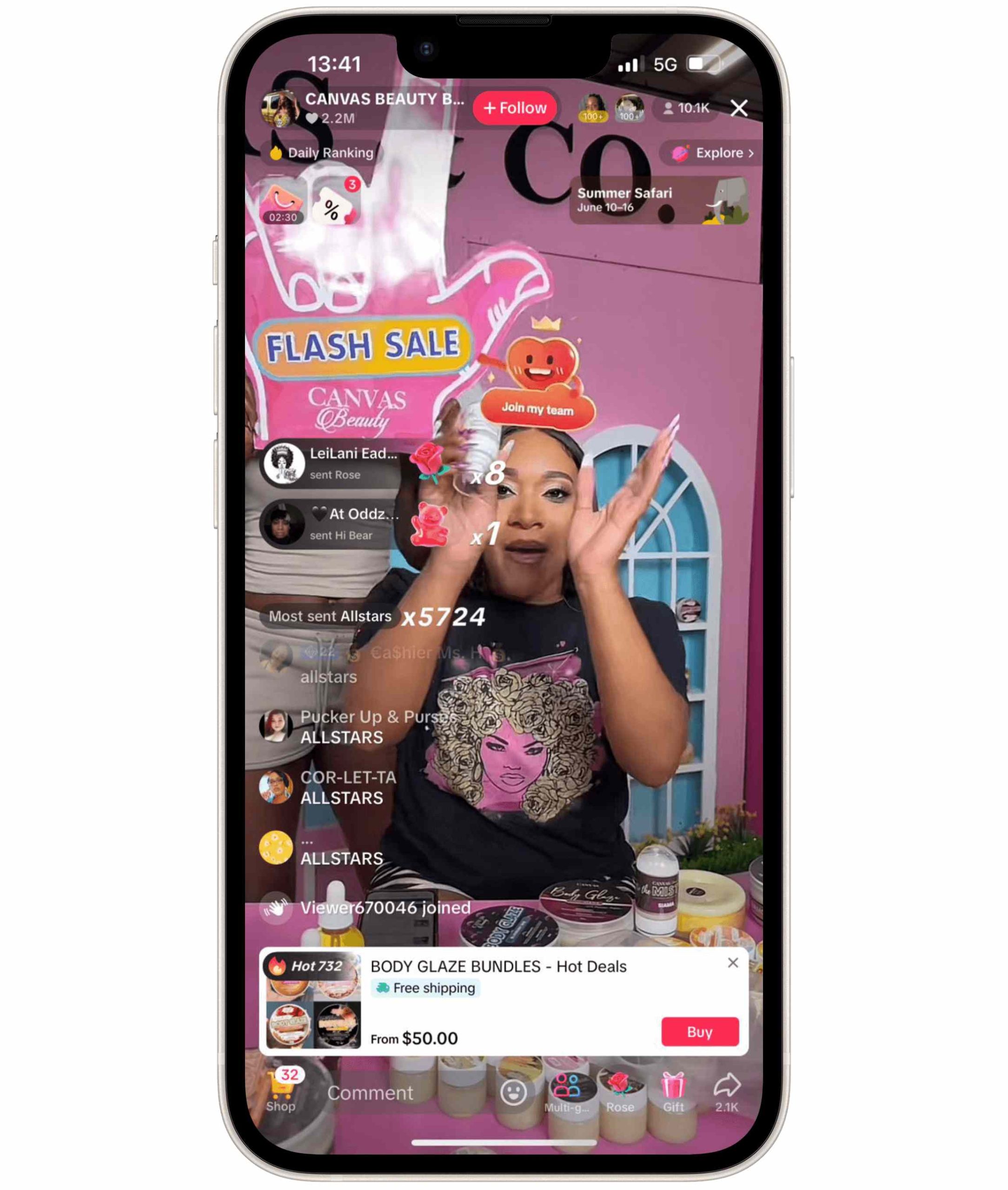
The single live event brought in over $1 million in direct sales and attracted more than 800,000 viewers. A few months later, Steele broke her own record by generating another $1 million in sales in just 3 hours during a subsequent live stream. This campaign proved how interactive live events can turn viewer attention into immediate orders.
PacSun: Scaling through micro-creator short videos
Apparel retailer PacSun demonstrated the impact of working with niche creators rather than relying exclusively on high-profile celebrities. PacSun partnered with a micro-creator who had just 5,000 followers to post a shoppable short video featuring a pair of low-rise jeans.
The short video showed an authentic fit demonstration with a clear product tag attached near the bottom of the screen. The video resonated with viewers, resulting in over 11,000 pairs of jeans sold in just 48 hours. This example highlights that a creator’s audience alignment matters far more than their total follower count.
Beachwaver: Daily live streams and packaging
Hair tool brand Beachwaver Co., founded by celebrity hairstylist Sarah Potempa, built a massive sales pipeline by making live shopping a daily operational habit. Beachwaver hosts frequent live streams where team members demonstrate rotating curling irons, answer styling questions, and pack customer orders live on camera while calling out buyers by name.
This consistent, community-focused approach helped Beachwaver surpass $100 million in total sales on TikTok Shop alone. By combining entertaining live demonstrations with real-time customer recognition, Beachwaver built a reliable channel for ongoing repeat purchases.
Practical challenges and solutions in social commerce
Selling directly on social networks comes with a few real-world obstacles. Here is how you can handle the most common challenges:
- Market saturation: Social feeds move quickly and users scroll past traditional ads. You can stand out by creating simple videos that show your product solving a real problem in the first few seconds.
- Platform dependency: Your performance entirely based on algorithms and platform policies. Platform updates can reduce your organic reach without warning, or ban your account over violations. You need to understand a platform deeply before establishing your business on it.
- High content demands: Social commerce requires a continuous stream of fresh videos and posts to stay visible in user feeds. You can manage this workload by building a network of micro-creators who create and tag user-generated content for you.
- Negative comments: Dissatisfied customers can leave public comments directly on your shoppable videos, visible to thousands of potential buyers. You can turn this into a positive by monitoring your comment sections daily, responding politely, and offering fast solutions to demonstrate strong customer service.
FAQs about social commerce
TikTok Shop, Meta Commerce (Instagram and Facebook Shops), and YouTube Shopping are the leading platforms for native social selling. Each platform provides tools like in-video product tags, live stream shopping cards, and dedicated profile storefronts.
No, setting up native storefronts on major social networks is generally free, and you can create product videos using a smartphone. Small brands can generate sales organically by posting clear demonstration clips and using creator affiliate programs.
Social media marketing focuses on building brand awareness, driving engagement, and encouraging users to visit an external website. Social commerce focuses on completing the actual sale directly inside the social app itself.
👉 Related:
7 Types of Content for Social Media to Build a Strong Community
Choose Social Media Content Pillars That You Won’t Regret Later
Short Form Videos for Social Media: Ultimate Guide (2026)
12 social media metrics to track after algorithms change in 2026